Learn what every symbol on the card means.Full credits and sources at beakbrain.com/symbols
 ForestDomed nestSmall · 30 g


ID tip
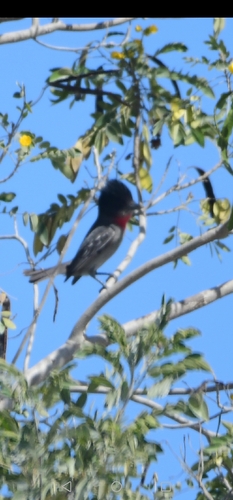
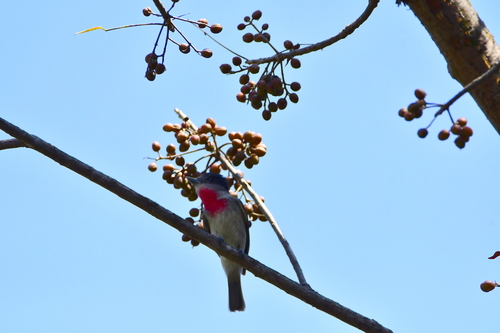
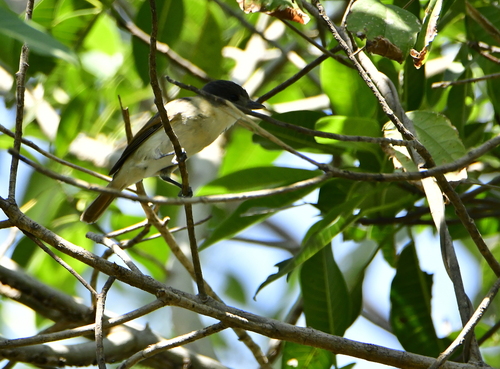
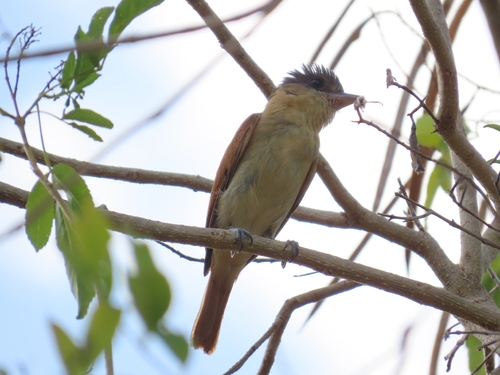
Rose-throated becards appear large-headed and show a dark gray to black crown or crest. Males tend to be pale gray in drier areas and significantly darker in rainforests, though always remaining countershaded gray. The diagnostic rose-colored throat patch is variable and not present across all populations, with the darkest males in rainforests having none at all. Males also have a hidden white shoulder patch which can be used during courtship, as well as a truncated ninth primary feather, the function of which is unknown.
Text from Wikipedia, licensed CC BY-SA 4.0.
When to see the Rose-throated Becard
One bar for each month, and every month is filled: this bird is recorded here in all twelve. The wide bar is March, the month with the most records.
Where to see the Rose-throated Becard
The map shades 9 countries with regular records. Everything unshaded has no records. Countries are listed below the map.
About the Rose-throated Becard
The rose-throated becard is a medium-sized passerine bird in the family Tityridae. It breeds from southeasternmost Arizona and extreme southern Texas in the United States and across Central America to western Panama. Males are mostly gray with a dark crest and have a characteristic rose-colored neck bib, which is absent in certain rainforest populations. Females also have a dark crest but are otherwise browner, with rusty-brown upperparts and pale buffy underparts.
Text adapted from Wikipedia, licensed CC BY-SA 4.0.
Easily confused with
 White-winged BecardPachyramphus polychopterusThe white-winged becard is 14 to 15.5 cm (5.5 to 6.1 in) long and weighs 19.5 to 21 g (0.69 to 0.74 oz).
 Cinnamon BecardPachyramphus cinnamomeusThe cinnamon becard is 14 to 15 cm (5.5 to 5.9 in) long and weighs 17 to 22 g (0.60 to 0.78 oz).
 Barred BecardPachyramphus versicolorThe barred becard is 12 to 13 cm (4.7 to 5.1 in) long and weighs 14 to 17 g (0.49 to 0.60 oz).
Side by side: Rose-throated Becard vs White-winged Becard · Cinnamon Becard vs Rose-throated Becard · Barred Becard vs Rose-throated Becard
Learn the Rose-throated Becard in the BeakBrain App
Photo and call practice. Coming soon to iPhone and Android.
Play today's Daily BirdEvery photo and recording on this page is credited to its author under the licence shown. Spotted a problem with this page, or have a better photo? Contribute.