Learn what every symbol on the card means.Full credits and sources at beakbrain.com/symbols
 ShrublandCup nestSmall · 24 g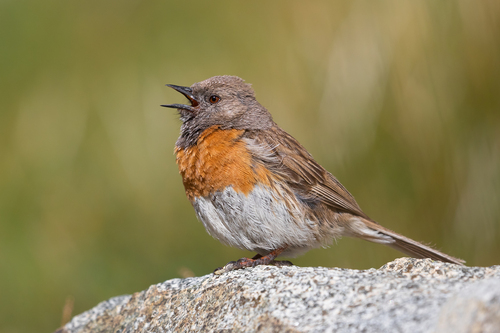


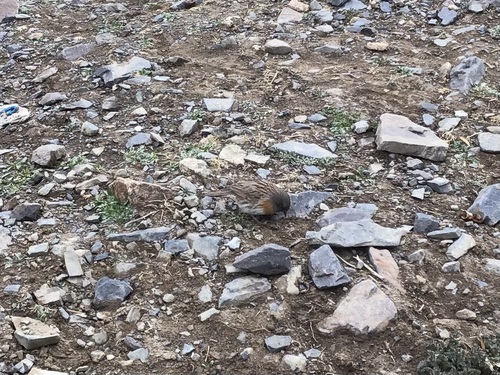
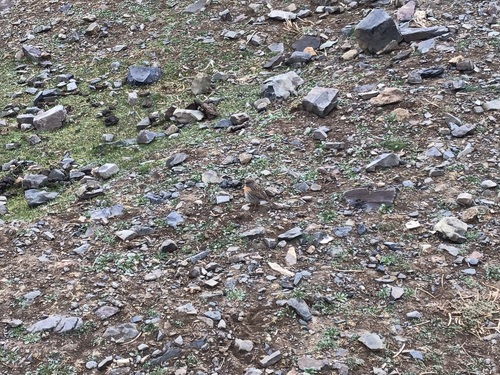
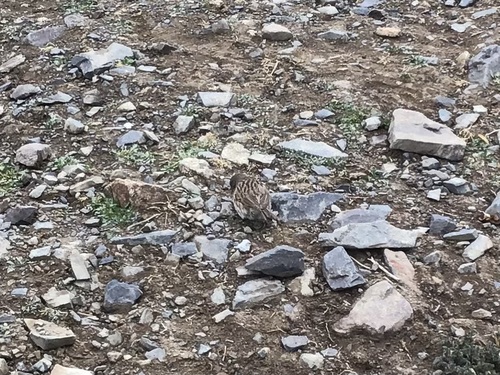
ID tip
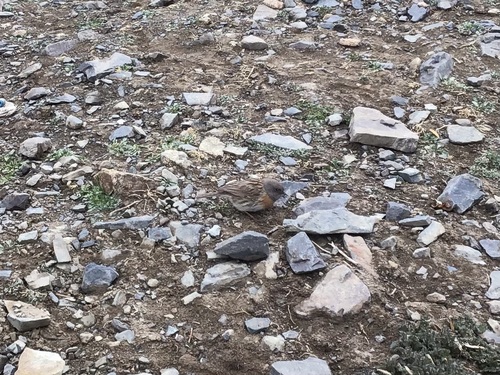
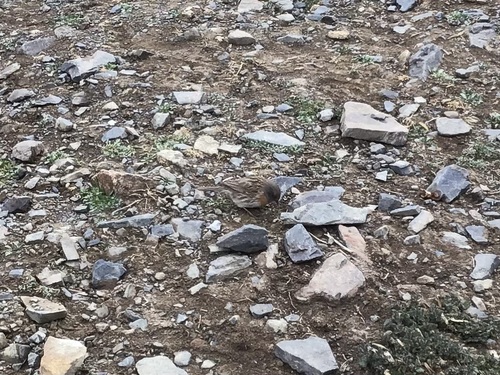
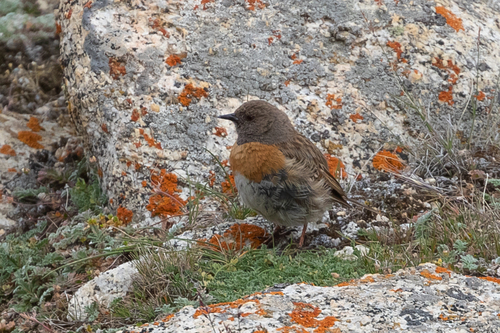
The robin accentor is a large accentor, growing to a length of about 17 cm (7 in). The sexes are similar in appearance and have the slender, sharply-pointed beak typical of an insect-eating bird. The head and neck are grey while the other upper parts are brown, streaked with black. The throat is a uniform shade of reddish-orange and the belly pale buff. The wing coverts have white tips. The call is a high trill, or a repeated "tszi tszi". The song is musical and has been rendered as "si-tsi-si-tsi-tsu-tsitsi".
Text from Wikipedia, licensed CC BY-SA 4.0.
When to see the Robin Accentor
One bar for each month. Filled bars are the 11 months with records; pale bars are months with none. The wide bar is July, the month with the most records.
Where to see the Robin Accentor
The map shades 5 countries with regular records. Everything unshaded has no records. Countries are listed below the map.
About the Robin Accentor
The robin accentor is a species of bird in the family Prunellidae. It is found in the mountainous regions of Afghanistan, Pakistan, India, Nepal, Bhutan and China, at altitudes between about 3,000 and 5,500 m. It is a brown bird with a grey head and an orange-red breast. It is common in parts of its range and its conservation status has been assessed by the International Union for Conservation of Nature as being of "least concern".
Text adapted from Wikipedia, licensed CC BY-SA 4.0.
Easily confused with
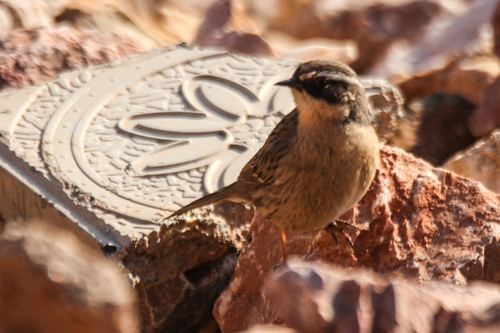 Brown AccentorPrunella fulvescensThey can be identified by their white supercilium (broader behind the eye), blackish-brown mask, blackish-brown ear-coverts, yellowish breast, and yellowish belly.
 Siberian AccentorPrunella montanellaThe Siberian accentor is on average 14.5 centimetres (5.7 in) long and weighs 17.5 grams (0.62 oz).
 Black-throated AccentorPrunella atrogularisThis is a dunnock-sized bird, 13.5–14 centimetres (5.3–5.5 in) in length.
Side by side: Alpine Accentor vs Robin Accentor · Robin Accentor vs Siberian Accentor · Brown Accentor vs Robin Accentor · Black-throated Accentor vs Robin Accentor
Learn the Robin Accentor in the BeakBrain App
Photo and call practice. Coming soon to iPhone and Android.
Play today's Daily BirdEvery photo and recording on this page is credited to its author under the licence shown. Spotted a problem with this page, or have a better photo? Contribute.