Learn what every symbol on the card means.Full credits and sources at beakbrain.com/symbols
 ShrublandCup nestMedium · 109 g


What the Ring Ouzel sounds like


ID tip
The ring ouzel is 23–24 centimetres (9.1–9.4 in) in length and weighs 90–138 grams (3.2–4.9 oz). The plumage of the male of the nominate race is entirely black except for a conspicuous white crescent on the breast, narrow greyish scaling on the upperparts and belly and pale edges to the wing feathers. The bill is yellow and the legs are greyish brown. The female resembles the male but is browner and with a duller breast band. Juveniles are like the female, but with a faint or non-existent breast crescent. Voice: The male ring ouzel sings from a low perch or occasionally in flight. The song consists of a repetition of 2–4 plaintive fluty notes, tri-ríí, tri-ríí, ti-ríí with pauses between repeats. The call is a loud tac-tac-tac, becoming harsher if the bird is alarmed. The contact call is a soft cherrr in flight. Males sing most frequently at dawn and sunset.
Text from Wikipedia, licensed CC BY-SA 4.0.
When to see the Ring Ouzel
One bar for each month. Filled bars are the 5 months with records; pale bars are months with none. The wide bar is April, the month with the most records.
Where to see the Ring Ouzel
The map shades 58 countries with regular records, and 1 more in a lighter tone where the bird turns up only as a stray. Everything unshaded has no records. Countries are listed below the map.
Recorded as a rare visitor in Lebanon.
About the Ring Ouzel
The ring ouzel is a mainly European member of the thrush family Turdidae. It is a medium-sized thrush, 23–24 centimetres (9.1–9.4 in) in length and weighing 90–138 grams (3.2–4.9 oz). The male is predominantly black with a conspicuous white crescent across its breast. Females are browner and duller than males, and young birds may lack the pale chest markings altogether. In all but the northernmost part of its range, this is a high-altitude species, with three subspecies breeding in mountains from Ireland east to Iran. It breeds in open mountain areas with some trees or shrubs, the latter often including juniper and other treeline conifers, rowan, bilberry, heather, and hairy alpenrose.
Text adapted from Wikipedia, licensed CC BY-SA 4.0.
Easily confused with
 Creamy-bellied ThrushTurdus amaurochalinusThe creamy-bellied thrush is 22 to 25 cm (8.7 to 9.8 in) long and weighs 52 to 73 g (1.8 to 2.6 oz).
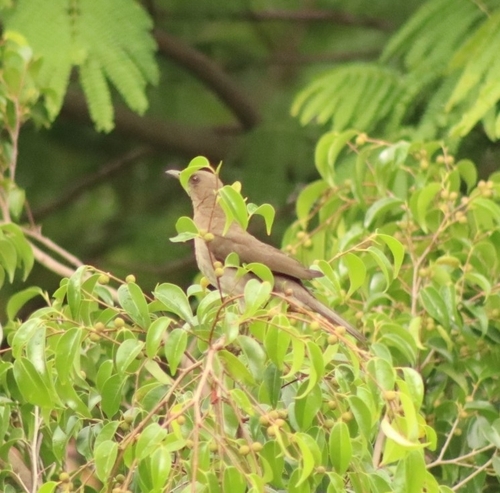 Black-billed ThrushTurdus ignobilisThe black-billed thrush is 18.5 to 24 cm (7.3 to 9.4 in) long and weighs 48 to 81 g (1.7 to 2.9 oz).
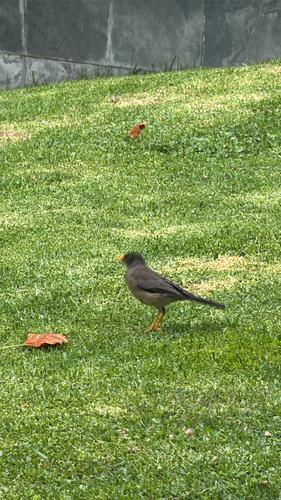 Austral ThrushTurdus falcklandiiThe austral thrush is 23 to 26.5 cm (9.1 to 10 in) long and weighs 95 to 113 g (3.4 to 4.0 oz).
Side by side: Creamy-bellied Thrush vs Ring Ouzel · Black-billed Thrush vs Ring Ouzel · Austral Thrush vs Ring Ouzel
Learn the Ring Ouzel in the BeakBrain App
Photo and call practice. Coming soon to iPhone and Android.
Play today's Daily BirdEvery photo and recording on this page is credited to its author under the licence shown. Spotted a problem with this page, or have a better photo? Contribute.