Learn what every symbol on the card means.Full credits and sources at beakbrain.com/symbols
 CoastalPlatform nestLarge · 516 g
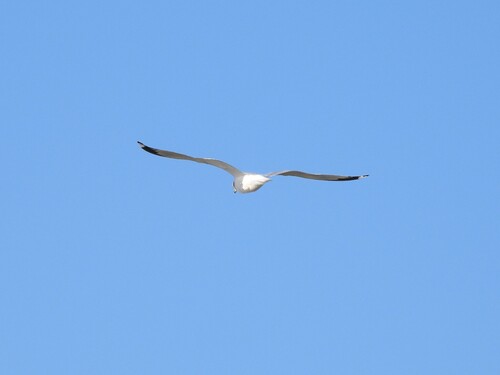
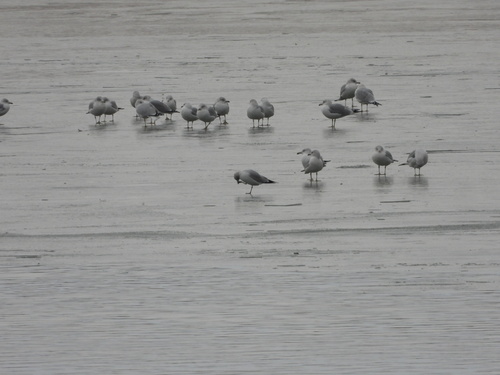

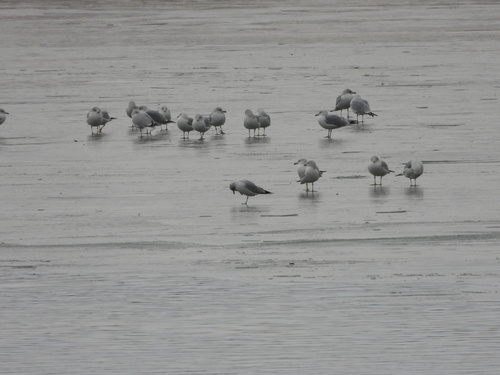
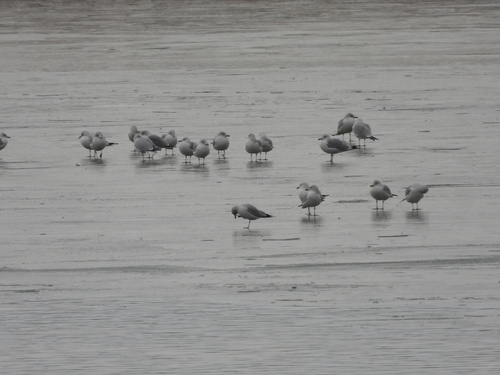


What the Ring-billed Gull sounds like

ID tip
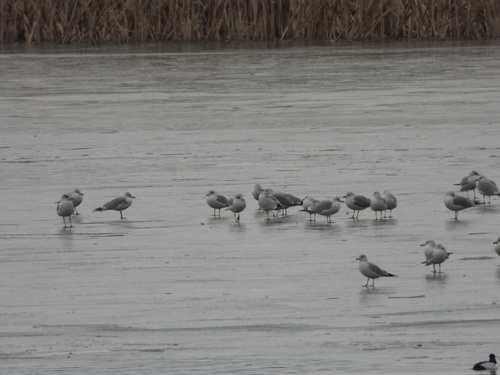
The ring-billed gull is a medium-sized gull, having an average length of 43 to 54 centimetres (16.9 to 21.3 in) and a wingspan that ranges from 105 to 117 centimetres (41.3 to 46.1 in). Adults weigh from 300 to 700 grams (10.6 to 24.7 oz). The head, neck and underparts are white; the relatively short bill is yellow with a black ring; the back and wings are silver grey with black wingtips with white 'mirrors'; and the legs are yellow. The eyes are yellow with red rims.
Text from Wikipedia, licensed CC BY-SA 4.0.
When to see the Ring-billed Gull
One bar for each month, and every month is filled: this bird is recorded here in all twelve. The wide bar is April, the month with the most records.
Where to see the Ring-billed Gull
The map shades 45 countries with regular records, and 12 more in a lighter tone where the bird turns up only as a stray. Everything unshaded has no records. Countries are listed below the map.
Recorded as a rare visitor in Germany, Netherlands, Italy, Ecuador, Denmark, Czechia, Morocco, Aruba, St. Barthélemy, Japan, Jersey, Russia.
About the Ring-billed Gull
The ring-billed gull is a medium-sized gull native to North America, breeding in Canada and the northern Contiguous United States, and wintering mainly in the United States and northern Mexico. The genus name is from Latin Larus which appears to have referred to a gull or other large seabird. The specific delawarensis refers to the Delaware River.
Text adapted from Wikipedia, licensed CC BY-SA 4.0.
Easily confused with
 American Herring GullLarus smithsonianusThe herring gull is a heavily built large gull with a long powerful bill, full chest and sloping forehead.
 Lesser Black-backed GullLarus fuscusThe lesser black-backed gull is smaller than the European herring gull.
 European Herring GullLarus argentatusThe male European herring gull is 60–67 cm (24–26 in) long and weighs 1,050–1,525 g (2.315–3.362 lb), while the female is 55–62 cm (22–24 in) and weighs 710–1,100 g (1.57–2.43 lb).
Side by side: American Herring Gull vs Ring-billed Gull · Lesser Black-backed Gull vs Ring-billed Gull · European Herring Gull vs Ring-billed Gull
Learn the Ring-billed Gull in the BeakBrain App
Photo and call practice. Coming soon to iPhone and Android.
Play today's Daily BirdEvery photo and recording on this page is credited to its author under the licence shown. Spotted a problem with this page, or have a better photo? Contribute.