Learn what every symbol on the card means.Full credits and sources at beakbrain.com/symbols
 ForestCavity nestMedium · 142 g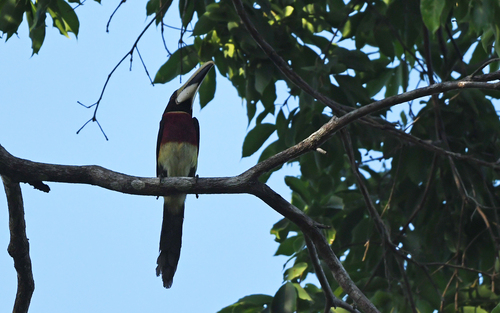
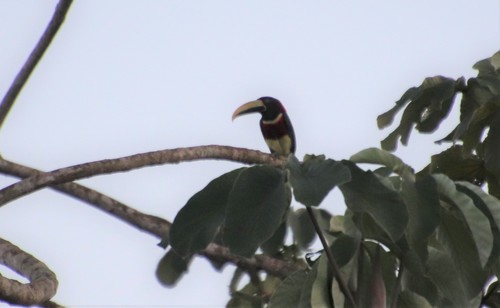

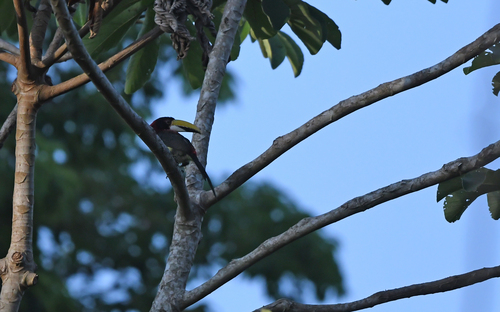
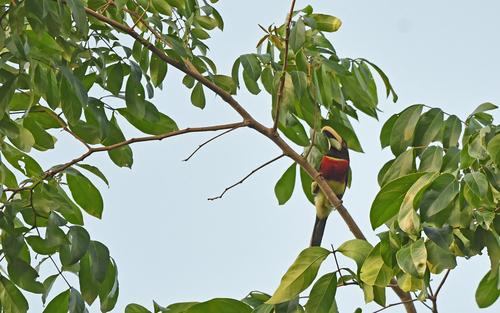
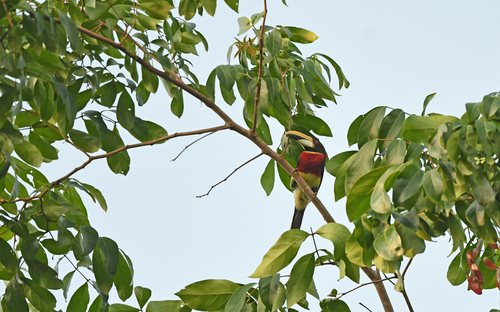
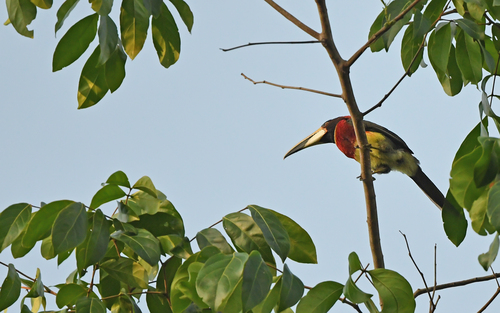
ID tip
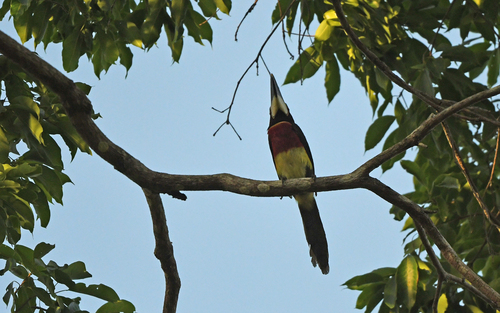
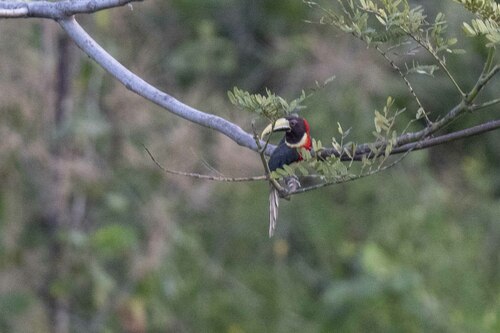
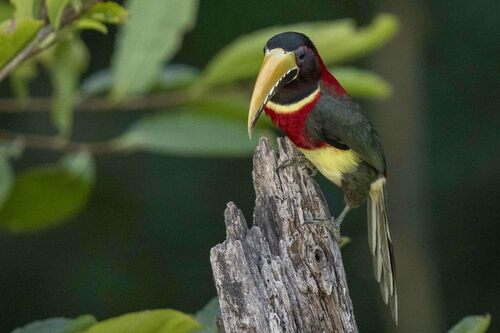
The red-necked aracari is about 36 to 40 cm (14 to 16 in) long and weighs 112 to 171 g (4.0 to 6.0 oz). The bill of the nominate subspecies has a yellow to greenish white maxilla with black and white along the edge that resembles teeth. The mandible has a white base that angles under the black of the rest of the mandible. Adult males have a blackish crown and dark brown face, chin, and throat. Their eye is surrounded by bare blue to greenish gray skin. Their nape and breast are red; yellow and black bands separate the latter from the throat. Voice: The red-necked aracari has a wide variety of vocalizations, variously repeated "tik or tek notes", repeated "ttak or tyat", and "single ik notes, a tweah, and growl-like, chattery dcheeeaah calls."
Text from Wikipedia, licensed CC BY-SA 4.0.
When to see the Red-necked Aracari
One bar for each month. Filled bars are the 7 months with records; pale bars are months with none. The wide bar is August, the month with the most records.
Where to see the Red-necked Aracari
The map shades 2 countries with regular records. Everything unshaded has no records. Countries are listed below the map.
About the Red-necked Aracari
The red-necked aracari or red-necked araçari is a bird in the toucan family Ramphastidae. It is found in Bolivia and Brazil.
Text adapted from Wikipedia, licensed CC BY-SA 4.0.
Easily confused with
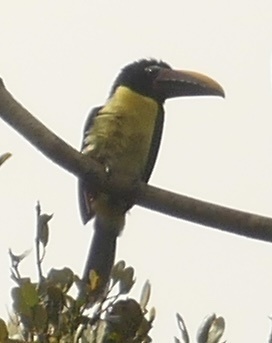 Green AracariPteroglossus viridisMales' crowns are black, while females' are reddish brown.
 Curl-crested AracariPteroglossus beauharnaisiiThe curl-crested aracari is 42 to 46 cm (17 to 18 in) long and weighs 164 to 280 g (5.8 to 9.9 oz).
 Saffron ToucanetPteroglossus bailloniIt is a relatively long-tailed toucan with a total length of 35–40 cm (14–15.5 in).
Learn the Red-necked Aracari in the BeakBrain App
Photo and call practice. Coming soon to iPhone and Android.
Play today's Daily BirdEvery photo and recording on this page is credited to its author under the licence shown. Spotted a problem with this page, or have a better photo? Contribute.