Learn what every symbol on the card means.Full credits and sources at beakbrain.com/symbols
 ForestCavity nestMedium · 135 g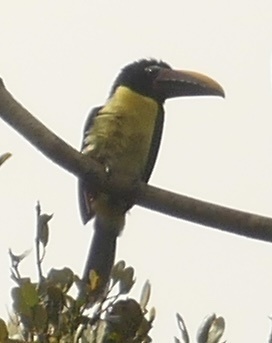
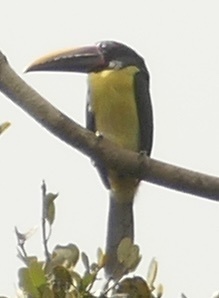


ID tip
Males' crowns are black, while females' are reddish brown.
Text from Wikipedia, licensed CC BY-SA 4.0.
When to see the Green Aracari
One bar for each month. Filled bars are the 11 months with records; pale bars are months with none. The wide bar is February, the month with the most records.
Where to see the Green Aracari
The map shades 5 countries with regular records, and 1 more in a lighter tone where the bird turns up only as a stray. Everything unshaded has no records. Countries are listed below the map.
Recorded as a rare visitor in Curaçao.
About the Green Aracari
The green araçari, is a toucan, a near-passerine bird. It is found in the lowland forests of northeastern South America, in the northeast Amazon Basin, the Guianas and the eastern Orinoco River drainage of Venezuela. At 30–40 cm. (12–16 in) long and weighing 110–160 grams, it is the smallest aracari in its range, and among the smallest members of the toucan family.
Text adapted from Wikipedia, licensed CC BY-SA 4.0.
Easily confused with
 Curl-crested AracariPteroglossus beauharnaisiiThe curl-crested aracari is 42 to 46 cm (17 to 18 in) long and weighs 164 to 280 g (5.8 to 9.9 oz).
 Saffron ToucanetPteroglossus bailloniIt is a relatively long-tailed toucan with a total length of 35–40 cm (14–15.5 in).
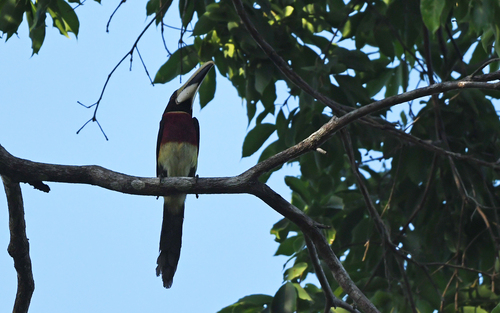 Red-necked AracariPteroglossus bitorquatusThe red-necked aracari is about 36 to 40 cm (14 to 16 in) long and weighs 112 to 171 g (4.0 to 6.0 oz).
Side by side: Green Aracari vs Ivory-billed Aracari · Green Aracari vs Saffron Toucanet · Curl-crested Aracari vs Green Aracari
Learn the Green Aracari in the BeakBrain App
Photo and call practice. Coming soon to iPhone and Android.
Play today's Daily BirdEvery photo and recording on this page is credited to its author under the licence shown. Spotted a problem with this page, or have a better photo? Contribute.