Learn what every symbol on the card means.Full credits and sources at beakbrain.com/symbols
 WoodlandCavity nestMedium · 60 g


ID tip
This barbet is one of the smaller of the Lybius species at only 17 cm (6.7 in) in length. It has red coloring on the side of the face and around the eye, but is black on the dorsal side of the head. Its entire body is black and its wings are streaked with yellow. This type of barbet is sexually monomorphic, meaning that both the males and females are generally similar in morphology, size and behavior. Voice: This species sings duets in order to communicate with mates and other individuals. Among its genus, the red-faced barbet is the only member to begin its duetting with a bill-snapping behavior. While individuals outside of a duetting pair will participate in "greeting ceremonies," duetting songs are generally exclusive to the primary pair communicating.
Text from Wikipedia, licensed CC BY-SA 4.0.
When to see the Red-faced Barbet
One bar for each month. Filled bars are the 9 months with records; pale bars are months with none. The wide bar is July, the month with the most records.
Where to see the Red-faced Barbet
The map shades 3 countries with regular records. Everything unshaded has no records. Countries are listed below the map.
About the Red-faced Barbet
The red-faced barbet is a species of bird in the African barbet family Lybiidae. It is found in Burundi, Rwanda, Northwest Tanzania, and Southwest Uganda. Its natural habitats are dry savanna, moist savanna, and arable land. It is threatened by habitat loss.
Text adapted from Wikipedia, licensed CC BY-SA 4.0.
Easily confused with
 Chaplin's BarbetLybius chapliniChaplin's barbet is a small bird species, measuring up to 19 cm (7.5 in) in length with a weight of 64–75 g (2.3–2.6 oz).
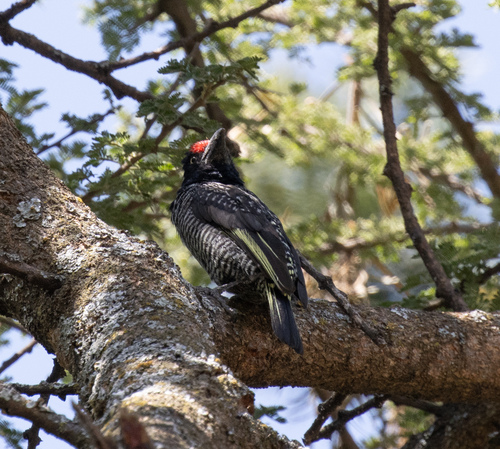 Banded BarbetLybius undatusThis barbet is approximately 20–25 cm long, stocky-looking, with a large head and a heavy bill with the bristles that the Lybius species is known for.
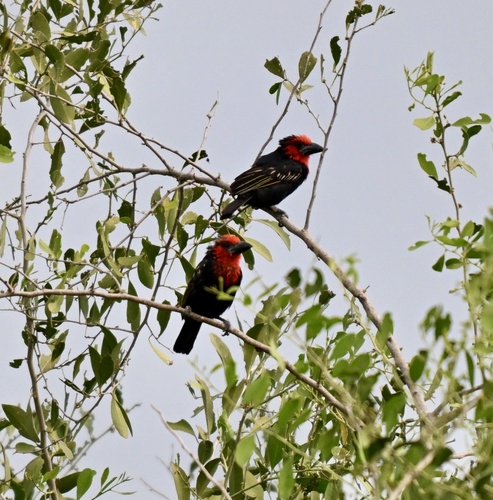 Black-billed BarbetLybius guifsobalitoLybius guifsobalito can reach a wingspan of 7.9–9.4 cm (3.1–3.7 in) in males.
Learn the Red-faced Barbet in the BeakBrain App
Photo and call practice. Coming soon to iPhone and Android.
Play today's Daily BirdEvery photo and recording on this page is credited to its author under the licence shown. Spotted a problem with this page, or have a better photo? Contribute.