Learn what every symbol on the card means.Full credits and sources at beakbrain.com/symbols
 WetlandPlatform nestHuge · 8.8 kg


ID tip
Adult red-crowned cranes are named for a patch of red bare skin on the crown, which becomes brighter during the mating season. Overall, they are snow white in color with black on the wing secondaries, which can appear almost like a black tail when the birds are standing, but the real tail feathers are actually white. Males are black on the cheeks, throat, and neck, while females are pearly gray in these spots. The bill is olive green to a greenish horn, the legs are slate to grayish black, and the iris is dark brown.
Text from Wikipedia, licensed CC BY-SA 4.0.
When to see the Red-crowned Crane
One bar for each month. Filled bars are the 8 months with records; pale bars are months with none. The wide bar is February, the month with the most records.
Where to see the Red-crowned Crane
The map shades 6 countries with regular records, and 6 more in a lighter tone where the bird turns up only as a stray. Everything unshaded has no records. Countries are listed below the map.
Recorded as a rare visitor in Spain, Germany, United States, France, North Korea, Denmark.
About the Red-crowned Crane
The red-crowned crane, also called the Japanese crane and the Manchurian crane, is a large Northeast Asian crane among the rarest cranes in the world. In some parts of its range, it is known as a symbol of luck, longevity, and fidelity.
Text adapted from Wikipedia, licensed CC BY-SA 4.0.
Easily confused with
 Black-necked CraneGrus nigricollisThis medium-sized crane is mostly grey with a black head and neck.
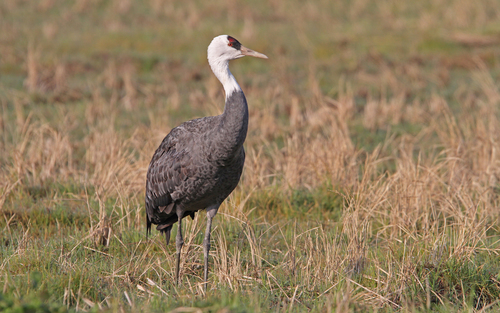 Hooded CraneGrus monachaIt has a grey body.
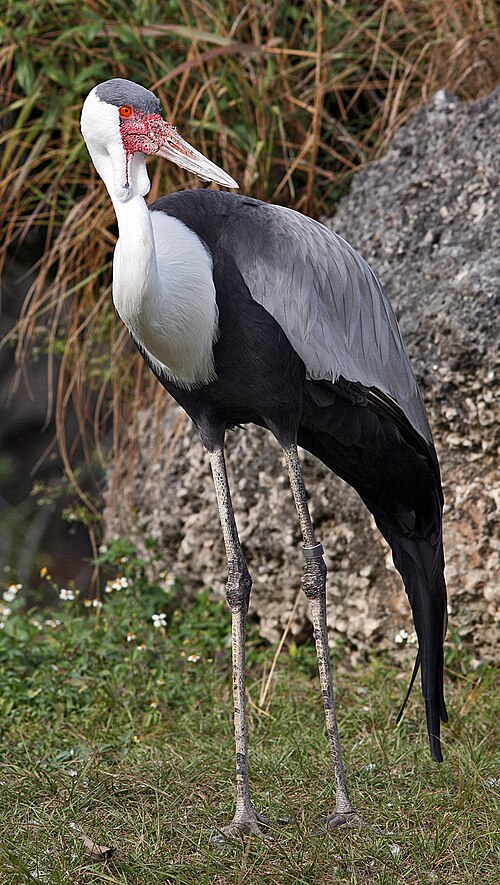 Wattled CraneGrus carunculataAt a height known to range from 150 to 175 cm (4 ft 11 in to 5 ft 9 in), it is the largest crane in Africa and is the second tallest species of crane in the world, after the sarus crane.
Side by side: Hooded Crane vs Red-crowned Crane · Black-necked Crane vs Red-crowned Crane · Red-crowned Crane vs Wattled Crane
Learn the Red-crowned Crane in the BeakBrain App
Photo and call practice. Coming soon to iPhone and Android.
Play today's Daily BirdEvery photo and recording on this page is credited to its author under the licence shown. Spotted a problem with this page, or have a better photo? Contribute.