Learn what every symbol on the card means.Full credits and sources at beakbrain.com/symbols
 ForestSmall · 50 g
ID tip
The red-banded fruiteater is the "most distinctive species in genus" Pipreola. It is about 16.5 to 17.5 cm (6.5 to 6.9 in) long. The sexes have very different plumage. Adult males of the nominate subspecies have a tawny-buff to rufous forehead, supercilium, and cheeks on an otherwise dark grayish green head. Their upperparts are also dark grayish green. Their wings and tail are rufous-brown. Their upper breast has a red crescent that becomes tawny on the sides of the neck. The rest of their underparts are mostly gray with ochre undertail coverts. Voice: The red-banded fruiteater seldom vocalizes. Both sexes do have a call, "a high, thin trill (almost a hiss) that drops initially then ascends smoothly throughout, tseeaaaaeeeeeeeeee...lasting 2-3 seconds". When excited, the species also makes a series of about six "high, thin ti notes".
Text from Wikipedia, licensed CC BY-SA 4.0.
When to see the Red-banded Fruiteater
One bar for each month. Filled bars are the 7 months with records; pale bars are months with none. The wide bar is February, the month with the most records.
Where to see the Red-banded Fruiteater
The map shades 2 countries with regular records, and 1 more in a lighter tone where the bird turns up only as a stray. Everything unshaded has no records. Countries are listed below the map.
Recorded as a rare visitor in Brazil.
About the Red-banded Fruiteater
The red-banded fruiteater is a species of bird in the family Cotingidae, the cotingas. It is found in Brazil, Guyana, and Venezuela.
Text adapted from Wikipedia, licensed CC BY-SA 4.0.
Easily confused with
 Handsome FruiteaterPipreola formosaThe handsome fruiteater is 16 to 18 cm (6.3 to 7.1 in) long and weighs 32.5 to 49 g (1.1 to 1.7 oz).
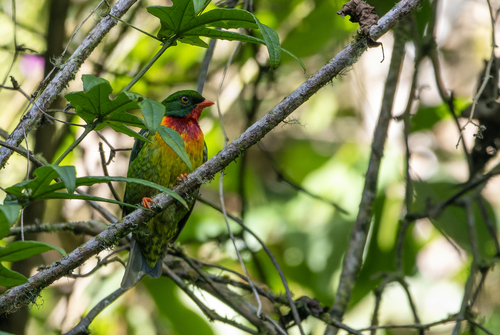 Scarlet-breasted FruiteaterPipreola frontalisLike all Pipreola fruiteaters, the scarlet-breasted fruiteater is a plump, short-tailed cotinga.
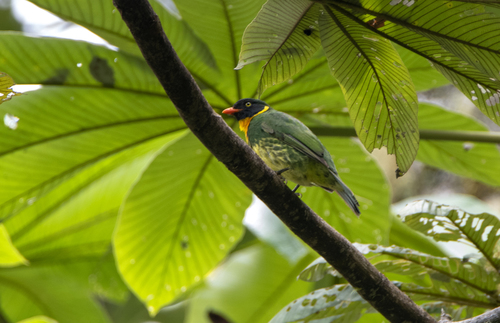 Masked FruiteaterPipreola pulchraAt 17 cm (7 in), the masked fruiteater is a medium-sized fruiteater.
Learn the Red-banded Fruiteater in the BeakBrain App
Photo and call practice. Coming soon to iPhone and Android.
Play today's Daily BirdEvery photo and recording on this page is credited to its author under the licence shown. Spotted a problem with this page, or have a better photo? Contribute.