Learn what every symbol on the card means.Full credits and sources at beakbrain.com/symbols
 ForestCup nestSmall · 42 g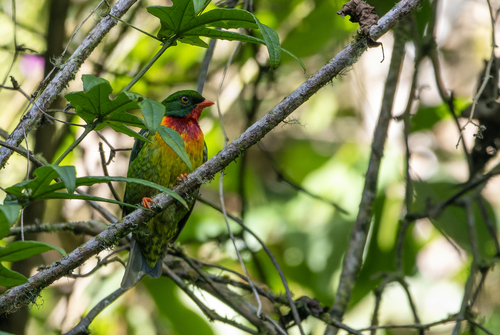
What the Scarlet-breasted Fruiteater sounds like


ID tip
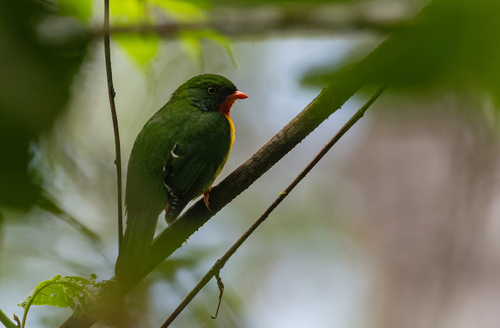
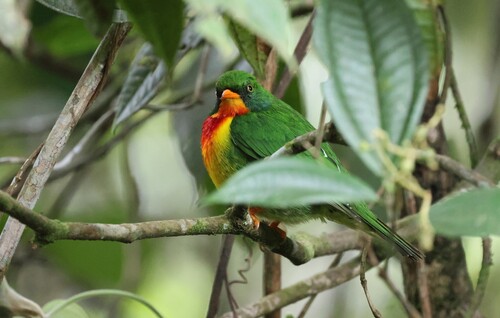
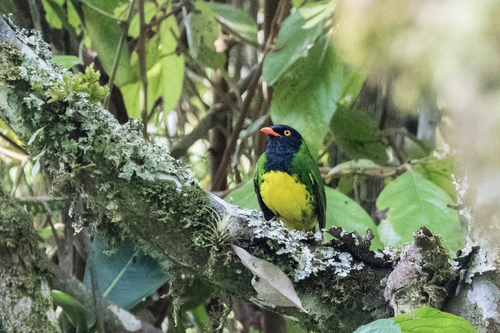
Like all Pipreola fruiteaters, the scarlet-breasted fruiteater is a plump, short-tailed cotinga. It is relatively small for a fruiteater, measuring 15.5–16.5 cm (6.1–6.5 in) in length; its mass ranges from 39.5 to 45.3 g (1.39 to 1.60 oz), with an average of 42.4 g (1.50 oz). The species is sexually dimorphic; the male is considerably more colorful than the female. Both sexes have bright green upperparts, with narrow yellow tips to the tertial feathers. The male's throat and upper breast are bright red (less extensively colored in P. f. squamipectus than in P. f. Voice: The scarlet-breasted fruiteater's vocalizations are generally short, high-pitched and infrequent. The song of the P. f. squamipectus male is sharp and ascending, variously transcribed as "psii" or "tsweeet", while the song of the P. f. frontalis male is longer and more complex—a thin, rising trill that becomes a descending whistle, transcribed as "ti'ti'ti'ti'ti'ti'tseeeeeeeeer".
Text from Wikipedia, licensed CC BY-SA 4.0.
When to see the Scarlet-breasted Fruiteater
One bar for each month. Filled bars are the 11 months with records; pale bars are months with none. The wide bar is August, the month with the most records.
Where to see the Scarlet-breasted Fruiteater
The map shades 3 countries with regular records. Everything unshaded has no records. Countries are listed below the map.
About the Scarlet-breasted Fruiteater
The scarlet-breasted fruiteater is a species of bird in the family Cotingidae. It is found in Bolivia, Ecuador, and Peru where its natural habitat is subtropical and tropical moist montane forests. Two subspecies are recognised though some researchers consider these should be regarded as distinct species. It is a plump green bird with a black head, the males having red throats and the females yellow. It is a relatively common species with a wide range, and the International Union for Conservation of Nature has rated its conservation status as being "least concern".
Text adapted from Wikipedia, licensed CC BY-SA 4.0.
Easily confused with
 Handsome FruiteaterPipreola formosaThe handsome fruiteater is 16 to 18 cm (6.3 to 7.1 in) long and weighs 32.5 to 49 g (1.1 to 1.7 oz).
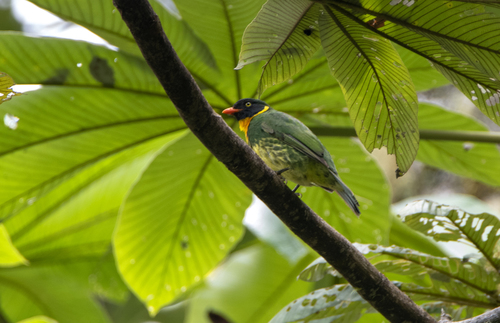 Masked FruiteaterPipreola pulchraAt 17 cm (7 in), the masked fruiteater is a medium-sized fruiteater.
 Black-chested FruiteaterPipreola lubomirskiiFruiteaters are stocky birds with short tails and short tarsi (lower legs).
Learn the Scarlet-breasted Fruiteater in the BeakBrain App
Photo and call practice. Coming soon to iPhone and Android.
Play today's Daily BirdEvery photo and recording on this page is credited to its author under the licence shown. Spotted a problem with this page, or have a better photo? Contribute.