Learn what every symbol on the card means.Full credits and sources at beakbrain.com/symbols
 RiverineDomed nestTiny · 11 g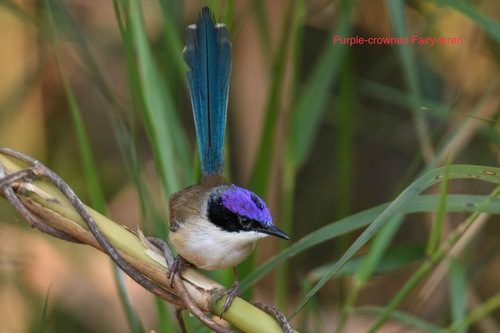
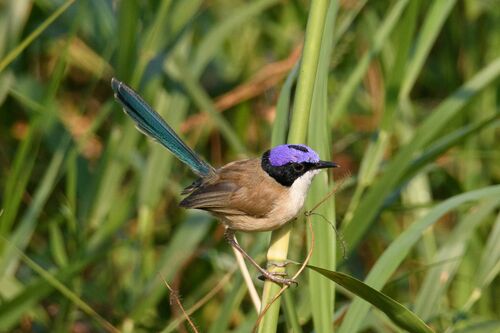


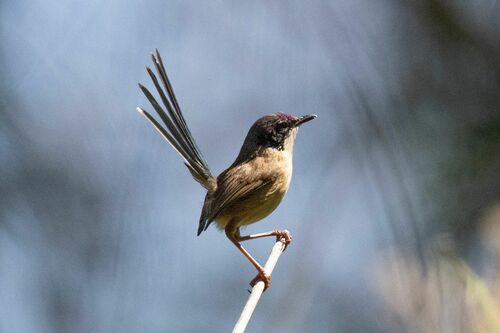

ID tip
The purple-crowned fairywren is a small, sexually dimorphic, bird measuring approximately 14 cm (5.5 in) in length, with a wing-span of approximately 16 cm (6.3 in) and weighing only 9–13 g (0.32–0.46 oz). It can be differentiated from other North Australian fairywrens by the presence of cheeks patches and the deep blue color of their tails. The plumage is brown overall, with the wings more greyish brown and the belly cream-buff. The blue tail is long and upright, and all except the central pair of feathers are broadly tipped with white. Voice: The song of the purple-crowned fairywren is distinct from that of other fairywrens – it is of lower pitch, and quite loud. Breeding pairs use song to communicate and use duets to ward off itinerant fairywrens from their territory.
Text from Wikipedia, licensed CC BY-SA 4.0.
When to see the Purple-crowned Fairywren
One bar for each month. Filled bars are the 7 months with records; pale bars are months with none. The wide bar is July, the month with the most records.
Where to see the Purple-crowned Fairywren
The map shades 1 country with regular records. Everything unshaded has no records. Countries are listed below the map.
About the Purple-crowned Fairywren
The purple-crowned fairywren is a species of bird in the Australasian wren family, Maluridae. It is the largest of the twelve species in the genus Malurus and is endemic to northern Australia. The species name is derived from the Latin word cǒrōna meaning "crown", owing to the distinctive purple circle of crown feathers sported by breeding males. Genetic evidence shows that the purple-crowned fairywren is most closely related to the superb fairywren and splendid fairywren. Purple-crowned fairywrens can be distinguished from other fairywrens in northern Australia by the presence of cheek patches and the deep blue colour of their perky tails.
Text adapted from Wikipedia, licensed CC BY-SA 4.0.
Easily confused with
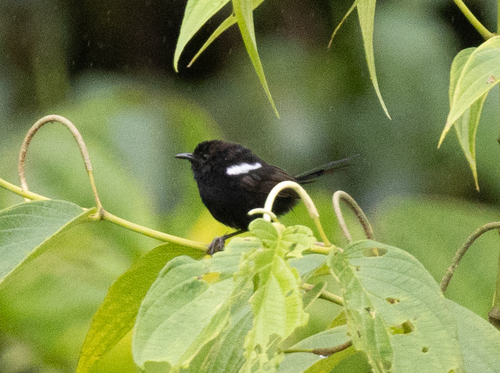 White-shouldered FairywrenMalurus alboscapulatusThe adult male is all shiny black except for their white shoulders (scapulars), but unlike the better-known Australian fairywrens there is no eclipse male plumage.
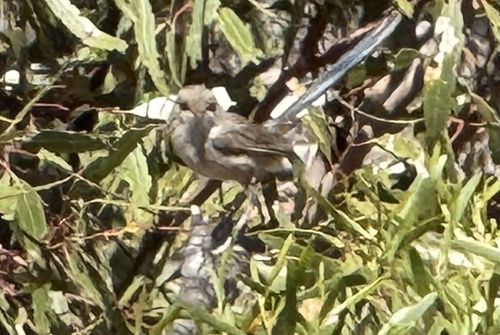 Blue-breasted FairywrenMalurus pulcherrimusThe contact call is a soft, short reed-like trill.
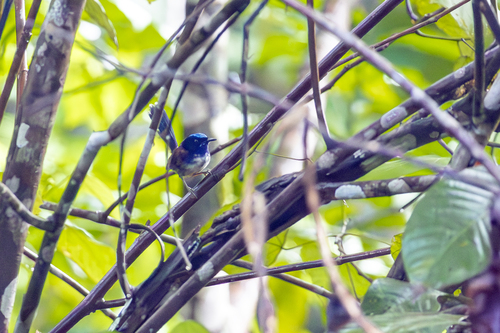 Emperor FairywrenMalurus cyanocephalusIt is the largest fairywren, being 13–16 cm (5.1–6.3 in) long and weighing 12–17 g (0.42–0.60 oz).
Learn the Purple-crowned Fairywren in the BeakBrain App
Photo and call practice. Coming soon to iPhone and Android.
Play today's Daily BirdEvery photo and recording on this page is credited to its author under the licence shown. Spotted a problem with this page, or have a better photo? Contribute.