Learn what every symbol on the card means.Full credits and sources at beakbrain.com/symbols
 ForestSmall · 21 g
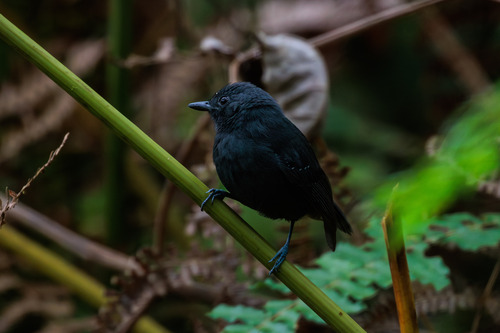
ID tip
The plumbeous antvireo is about 12 to 13 cm (4.7 to 5.1 in) long. Adult males have a dark gray head, upperparts, and tail with a hidden white patch between the scapulars. Their wings are black with white tips and edges on the coverts. Their underparts are a darker blackish gray than the upperparts. Adult females have an olive-brown head and upperparts with buff-white spots on the wing coverts. Their throat is very pale gray, their breast olive-brown, and their belly and crissum ochraceous. Voice: The plumbeous antvireo's song is a "slow series of 6-8 evenly spaced, rising and falling, sad-sounding notes".
Text from Wikipedia, licensed CC BY-SA 4.0.
When to see the Plumbeous Antvireo
One bar for each month. Filled bars are the 11 months with records; pale bars are months with none. The wide bar is October, the month with the most records.
Where to see the Plumbeous Antvireo
The map shades 1 country with regular records, and 1 more in a lighter tone where the bird turns up only as a stray. Everything unshaded has no records. Countries are listed below the map.
Recorded as a rare visitor in Colombia.
About the Plumbeous Antvireo
The plumbeous antvireo is a Vulnerable species of bird in subfamily Thamnophilinae of family Thamnophilidae, the "typical antbirds". It is endemic to Brazil.
Text adapted from Wikipedia, licensed CC BY-SA 4.0.
Easily confused with
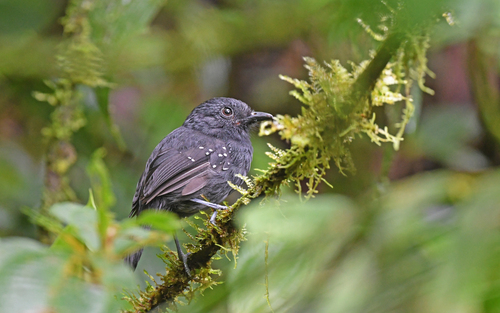 Bicolored AntvireoDysithamnus occidentalisThe bicolored antvireo is about 13 to 13.5 cm (5.1 to 5.3 in) long.
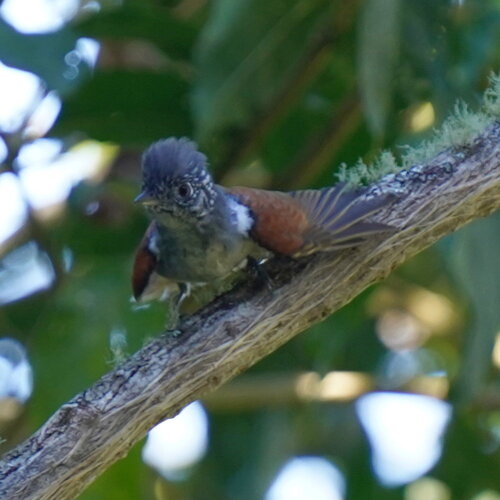 Rufous-backed AntvireoDysithamnus xanthopterusThe rufous-backed antvireo is about 12 cm (4.7 in) long.
Learn the Plumbeous Antvireo in the BeakBrain App
Photo and call practice. Coming soon to iPhone and Android.
Play today's Daily BirdEvery photo and recording on this page is credited to its author under the licence shown. Spotted a problem with this page, or have a better photo? Contribute.