Learn what every symbol on the card means.Full credits and sources at beakbrain.com/symbols
 ForestCup nestSmall · 16 g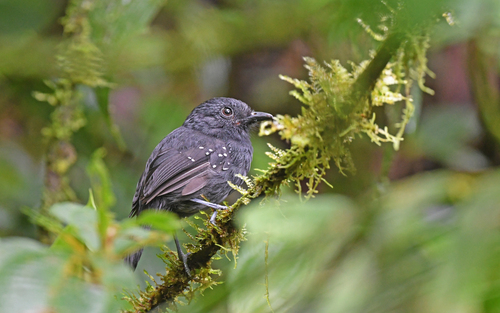
What the Bicolored Antvireo sounds like


ID tip
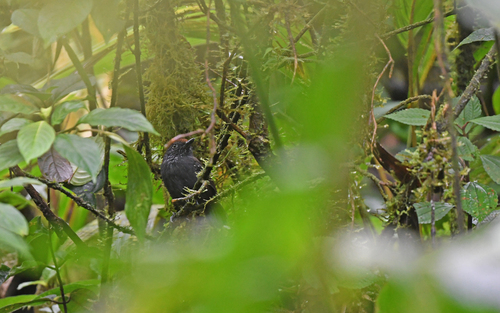
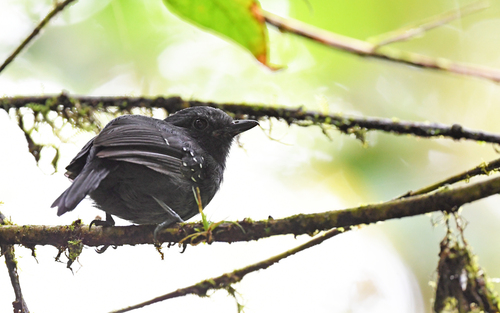
The bicolored antvireo is about 13 to 13.5 cm (5.1 to 5.3 in) long. Adult males of the nominate subspecies D. o. occidentalis have a blackish gray head, upperparts, and tail with a mostly-hidden white patch between the scapulars. Their wings are black with white dots on the greater and median coverts and mostly white lesser coverts which are mostly hidden. Their underparts are a slightly lighter blackish gray than the upperparts. Adult females have a chestnut crown and upperparts with buffy white spots on the wing coverts. Voice: The bicolored antvireo's song has not been identified with certainty; one of the vocalizations thought to be a call might be the song. In Ecuador the species' most common call is a "fast throaty scold, 'jeér-deer-dur' ". In that country it also makes "clear 'peeu' calls" and "a fast ascending 'pu-pu-pooyeh?' ". Schulenberg et al.
Text from Wikipedia, licensed CC BY-SA 4.0.
When to see the Bicolored Antvireo
One bar for each month. Filled bars are the 11 months with records; pale bars are months with none. The wide bar is August, the month with the most records.
Where to see the Bicolored Antvireo
The map shades 2 countries with regular records, and 1 more in a lighter tone where the bird turns up only as a stray. Everything unshaded has no records. Countries are listed below the map.
Recorded as a rare visitor in Peru.
About the Bicolored Antvireo
The bicolored antvireo is a Near Threatened insectivorous bird in subfamily Thamnophilinae of family Thamnophilidae, the "typical antbirds". It is found in Colombia, Ecuador, and Peru.
Text adapted from Wikipedia, licensed CC BY-SA 4.0.
Easily confused with
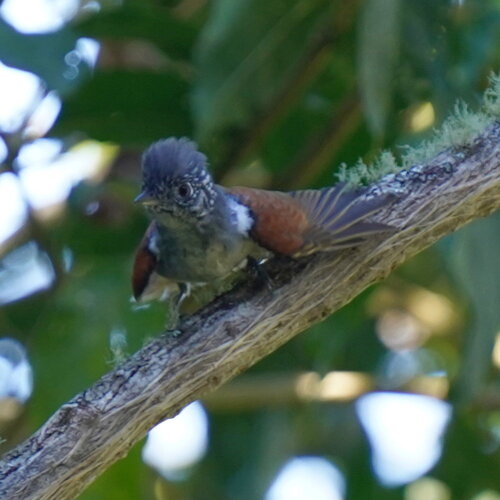 Rufous-backed AntvireoDysithamnus xanthopterusThe rufous-backed antvireo is about 12 cm (4.7 in) long.
White-streaked AntvireoDysithamnus leucostictusThe white-streaked antvireo is 12 to 13 cm (4.7 to 5.1 in) long and weighs about 20 g (0.71 oz).
Rufous-backed AntvireoDysithamnus xanthopterusThe rufous-backed antvireo is about 12 cm (4.7 in) long.
White-streaked AntvireoDysithamnus leucostictusThe white-streaked antvireo is 12 to 13 cm (4.7 to 5.1 in) long and weighs about 20 g (0.71 oz).
 Plumbeous AntvireoDysithamnus plumbeusThe plumbeous antvireo is about 12 to 13 cm (4.7 to 5.1 in) long.
Learn the Bicolored Antvireo in the BeakBrain App
Photo and call practice. Coming soon to iPhone and Android.
Play today's Daily BirdEvery photo and recording on this page is credited to its author under the licence shown. Spotted a problem with this page, or have a better photo? Contribute.