Learn what every symbol on the card means.Full credits and sources at beakbrain.com/symbols
 ShrublandCavity nestLarge · 563 g


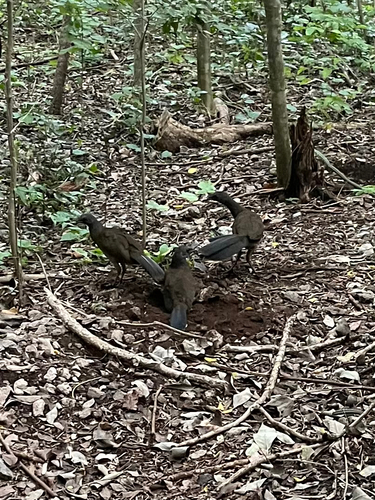
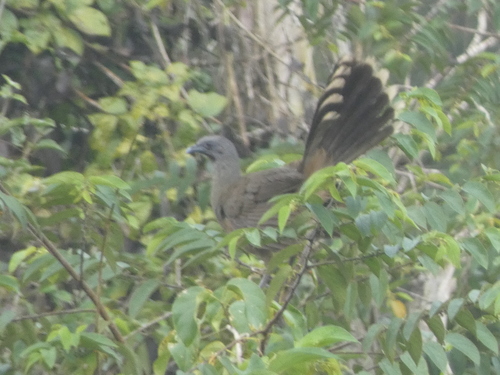
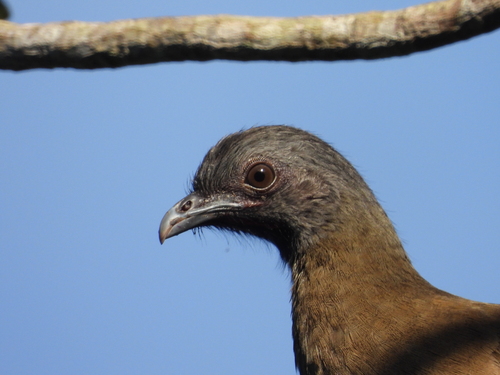

ID tip
The plain chachalaca is a medium-sized galliform, around the size of a common pheasant. It measures 48–58 cm (19–23 in) in length, and varies in weight from 468–794 g (16.5–28.0 oz) for males and 439–707 g (15.5–24.9 oz)in females Males are on average larger but because of overlap that isn't diagnostic of sex, and in appearance they are the same. It is long-necked with a small head and bare throat patch which becomes deep red in both sexes during the breeding season. Adults have a greyish head and neck with a dull olive-brown body and wings.
Text from Wikipedia, licensed CC BY-SA 4.0.
When to see the Plain Chachalaca
One bar for each month. Filled bars are the 10 months with records; pale bars are months with none. The wide bar is March, the month with the most records.
Where to see the Plain Chachalaca
The map shades 8 countries with regular records. Everything unshaded has no records. Countries are listed below the map.
About the Plain Chachalaca
The plain chachalaca is a large bird in the chachalaca, guan and curassow family Cracidae. It breeds in tropical and subtropical environments from mezquital thickets in the Rio Grande Valley in southernmost Texas, United States to northernmost Costa Rica. In Central America, this species occurs in the Pacific lowlands from Chiapas, Mexico to northern Nicaragua and as a separate population in Costa Rica, where its range is separated by a short distance, as a disjunct population.
Text adapted from Wikipedia, licensed CC BY-SA 4.0.
Easily confused with
 Grey-headed ChachalacaOrtalis cinereicepsThe grey-headed chachalaca is a medium-sized bird, similar in general appearance to turkeys, with a small head, long strong legs, and a long broad tail.
 Colombian ChachalacaOrtalis columbianaThe Colombian chachalaca is a typical Ortalis species – a large, plump forest bird with a long slender neck, small head, long and robust legs (tarsi) and a long tail.
 Speckled ChachalacaOrtalis guttataThe speckled chachalaca is 49 to 55 cm (1.6 to 1.8 ft) long.
Side by side: Grey-headed Chachalaca vs Plain Chachalaca · Colombian Chachalaca vs Plain Chachalaca · Plain Chachalaca vs Speckled Chachalaca
Learn the Plain Chachalaca in the BeakBrain App
Photo and call practice. Coming soon to iPhone and Android.
Play today's Daily BirdEvery photo and recording on this page is credited to its author under the licence shown. Spotted a problem with this page, or have a better photo? Contribute.