Learn what every symbol on the card means.Full credits and sources at beakbrain.com/symbols
 WetlandScrapeLarge · 304 g




What the Pied Avocet sounds like


ID tip
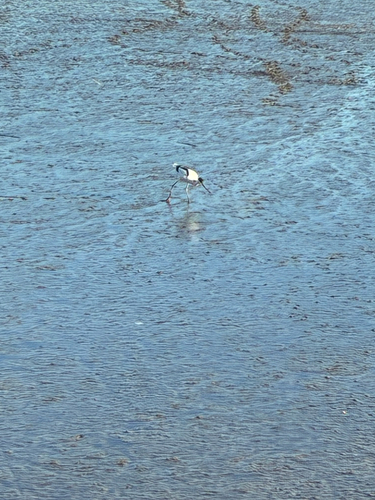
Adults have a striking black-and-white plumage, with a black cap extending to the back of the neck. The primaries are black, with the base of the inner primaries white, while the secondary coverts are dark grey. The rectrices are pale grey-brown in the middle and white elsewhere. The species shows no seasonal plumage variation. The tail is white, and the legs are bluish. The long, black beak is slender and upturned. Sexual dimorphism is subtle and difficult to discern in the field. The male's bill is longer and less curved, while the female's is shorter and more distinctly curved.
Text from Wikipedia, licensed CC BY-SA 4.0.
When to see the Pied Avocet
One bar for each month, and every month is filled: this bird is recorded here in all twelve. The wide bar is May, the month with the most records.
Where to see the Pied Avocet
The map shades 107 countries with regular records, and 8 more in a lighter tone where the bird turns up only as a stray. Everything unshaded has no records. Countries are listed below the map.
Recorded as a rare visitor in Cape Verde, Congo - Kinshasa, Libya, Guernsey, Gabon, Lebanon, Gibraltar, Luxembourg.
About the Pied Avocet
The pied avocet is a species of wader in the Recurvirostridae family, the only member of the avocet genus Recurvirostra found in Europe, Africa, and Asia.
Text adapted from Wikipedia, licensed CC BY-SA 4.0.
Easily confused with
 American AvocetRecurvirostra americanaThe American avocet measures 40–51 cm (16–20 in) in length, has a wingspan of 68–76 cm (27–30 in) and weighs 275–420 g (9.7–14.8 oz) The bill is black, pointed, and curved slightly upwards towards the tip.
 Red-necked AvocetRecurvirostra novaehollandiaeThe distinguishing feature of the red-necked avocet, and all avocet species, is the distinctive upcurved bill that is used for skimming the surface of water to catch small invertebrates.
 Andean AvocetRecurvirostra andinaThis avocet has a white head, neck, underparts and rump, and dark brown back, wings and tail.
Side by side: American Avocet vs Pied Avocet · Pied Avocet vs Red-necked Avocet · Andean Avocet vs Pied Avocet
Learn the Pied Avocet in the BeakBrain App
Photo and call practice. Coming soon to iPhone and Android.
Play today's Daily BirdEvery photo and recording on this page is credited to its author under the licence shown. Spotted a problem with this page, or have a better photo? Contribute.