Learn what every symbol on the card means.Full credits and sources at beakbrain.com/symbols
 ForestCavity nestMedium · 178 g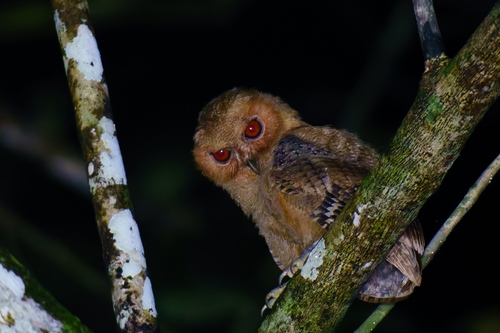


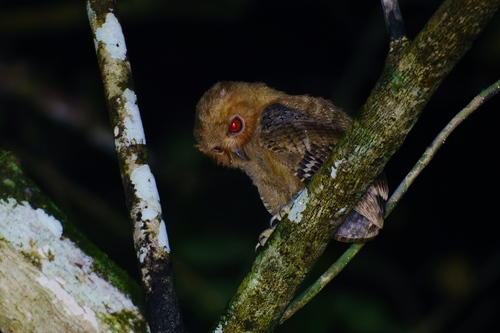
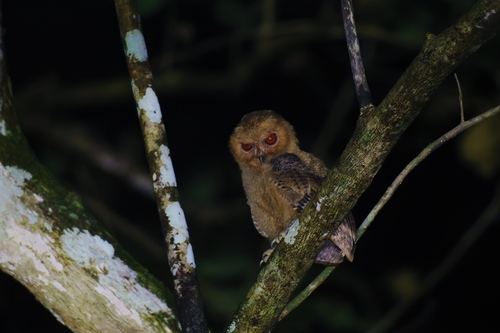
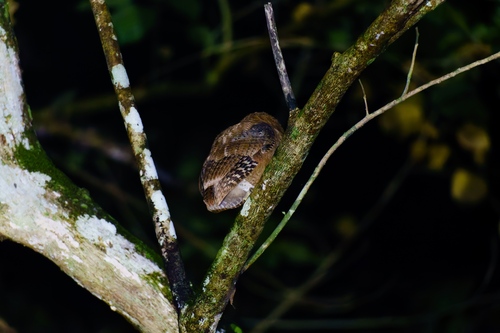
ID tip
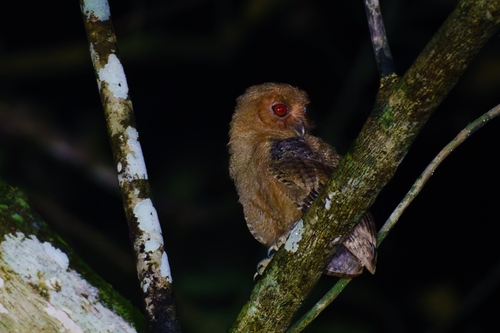
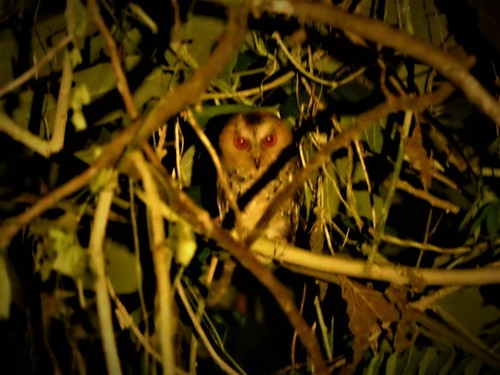
The Philippine scops owl is a fairly small-to-mid-sized species of owl, but is arguably the largest true species of scops owl. Adults measure from 23 to 28 cm (9.1 to 11.0 in). Their body mass can range from 125 to 310 g (4.4 to 10.9 oz), with females often considerably larger than males. A distinguishing feature of this owl is its large ears that stand upright on its head. They also have big eyes that are dark in the center with a red/orange edge. In general, these owls are covered in dark brown feathers with dark streaks. Their ear-tufts also have a similar pattern. Voice: Philippine scops owls are a nocturnal species and vocalize more actively at night. Their song corresponds to "oik oik oik ook" with long and powerful notes that are clearly distinguished from one another. The last "ook" is lower than the previous three notes. Their call sounds completely different with a series of three to six escalating notes that are loud and abrupt.
Text from Wikipedia, licensed CC BY-SA 4.0.
When to see the Philippine Scops Owl
One bar for each month. Filled bars are the 9 months with records; pale bars are months with none. The wide bar is February, the month with the most records.
Where to see the Philippine Scops Owl
The map shades 1 country with regular records. Everything unshaded has no records. Countries are listed below the map.
About the Philippine Scops Owl
The Philippine scops owl, also Luzon lowland scops owl is a common owl, endemic to the Philippines, belonging to the family of the typical owls Strigidae. Other common names include "Otus Whitehead", "Whitehead scops owl" and "Luzon lowland scops owl". Everett's scops owl and Negros scops owls were formerly considered conspecific but are now classified as separate species.
Text adapted from Wikipedia, licensed CC BY-SA 4.0.
Easily confused with
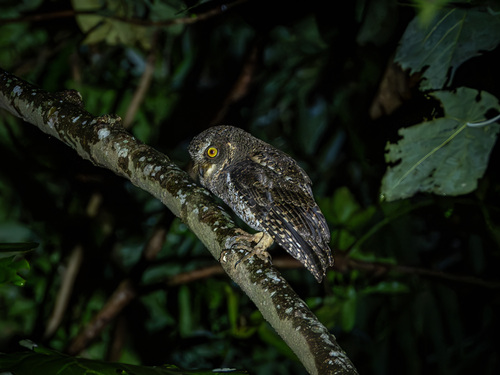 Sulawesi Scops OwlOtus manadensisThe Sulawesi scops owl is an owl found on the Sulawesi island of Indonesia.
Andaman Scops OwlOtus balliThe Andaman scops owl is between 18 and 19 cm in height.
Sulawesi Scops OwlOtus manadensisThe Sulawesi scops owl is an owl found on the Sulawesi island of Indonesia.
Andaman Scops OwlOtus balliThe Andaman scops owl is between 18 and 19 cm in height.
 Reddish Scops OwlOtus rufescensThe reddish scops owl measures 15-18 cm in length and has a body mass of 70-83 g.
Learn the Philippine Scops Owl in the BeakBrain App
Photo and call practice. Coming soon to iPhone and Android.
Play today's Daily BirdEvery photo and recording on this page is credited to its author under the licence shown. Spotted a problem with this page, or have a better photo? Contribute.