Learn what every symbol on the card means.Full credits and sources at beakbrain.com/symbols
 ForestCavity nestMedium · 123 g
ID tip
The Andaman scops owl is between 18 and 19 cm in height. They occur in red-brown and grey-brown morphs. The species is also noted for its prominent ear tufts and pale eyebrows. The upperparts of the owl are spotted with black and white spots. In addition, white spots can be seen along the neck and crown area. In contrast to the upperparts, the underparts are pale and grey. The tail will be brown and tan while the feathers will appear brown, tan, and white. The owl notably also can have bright yellow irises that could also occur in brown or hazel.
Text from Wikipedia, licensed CC BY-SA 4.0.
When to see the Andaman Scops Owl
One bar for each month. Filled bars are the 7 months with records; pale bars are months with none. The wide bar is December, the month with the most records.
Where to see the Andaman Scops Owl
The map shades 1 country with regular records. Everything unshaded has no records. Countries are listed below the map.
About the Andaman Scops Owl
The Andaman scops owl is a species of the Strigidae family and is native to the Andaman Islands of India. It is a largely brown owl with white speckles and yellow eyes. The owl was first described in 1873 by British ornithologist Allan Octavian Hume. The Andaman scops owl has no sightings outside of the Andaman Islands, therefore research on this bird is limited. This owl is not threatened, though an increase in deforestation on the islands has led to the population size slowly declining. It is a nocturnal owl that feeds at night and has a nesting season from February to April.
Text adapted from Wikipedia, licensed CC BY-SA 4.0.
Easily confused with
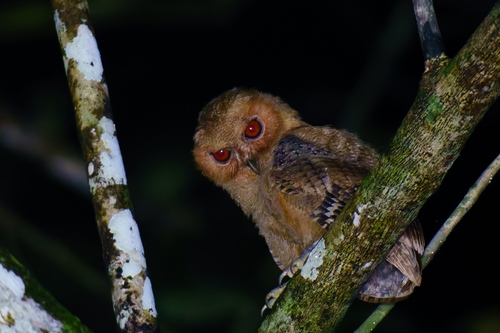 Philippine Scops OwlOtus megalotisThe Philippine scops owl is a fairly small-to-mid-sized species of owl, but is arguably the largest true species of scops owl.
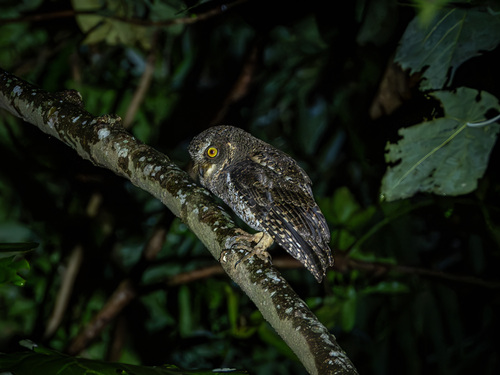 Sulawesi Scops OwlOtus manadensisThe Sulawesi scops owl is an owl found on the Sulawesi island of Indonesia.
 Reddish Scops OwlOtus rufescensThe reddish scops owl measures 15-18 cm in length and has a body mass of 70-83 g.
Learn the Andaman Scops Owl in the BeakBrain App
Photo and call practice. Coming soon to iPhone and Android.
Play today's Daily BirdEvery photo and recording on this page is credited to its author under the licence shown. Spotted a problem with this page, or have a better photo? Contribute.