Learn what every symbol on the card means.Full credits and sources at beakbrain.com/symbols


What the Peruvian Racket-tail sounds like


ID tip
All racket-tails have pronounced sexual dimorphism. Only the male has elongated outer rectrices (tail feathers) that have bare shafts with terminal flags. On the Peruvian racket-tail, those feathers are straight and do not cross; the flags are narrow ovals that slightly overlap. Male Peruvian racket-tails are 11 to 15 cm (4.3 to 5.9 in) long including the 7 to 8 cm (2.8 to 3.1 in) long outer tail feathers, and weigh 2.5 to 2.7 g (0.088 to 0.095 oz). Females are 7.6 to 9 cm (3.0 to 3.5 in) long and weigh 2.6 to 3.2 g (0.092 to 0.11 oz). Voice: Both male and female Peruvian racket-tails give "a diagnostic, descending, thin sweet trill, 'ti-tlee-ee-ee' single 'tsit' and 'trrt' notes."
Text from Wikipedia, licensed CC BY-SA 4.0.
When to see the Peruvian Racket-tail
One bar for each month, and every month is filled: this bird is recorded here in all twelve. The wide bar is October, the month with the most records.
Where to see the Peruvian Racket-tail
The map shades 3 countries with regular records. Everything unshaded has no records. Countries are listed below the map.
About the Peruvian Racket-tail
The Peruvian racket-tail is a species of hummingbird in the "brilliants", tribe Heliantheini in subfamily Lesbiinae. It is found in Ecuador and Peru.
Text adapted from Wikipedia, licensed CC BY-SA 4.0.
Easily confused with
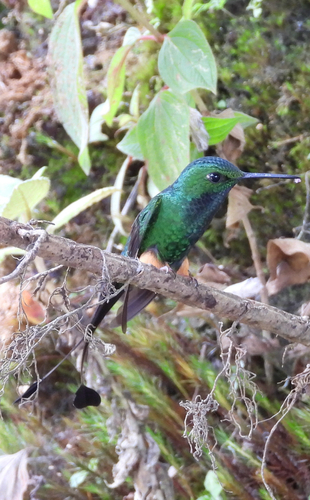 Rufous-booted Racket-tailOcreatus addaeAll racket-tails have pronounced sexual dimorphism.
 White-booted Racket-tailOcreatus underwoodiiAll racket-tails have pronounced sexual dimorphism.
Side by side: Peruvian Racket-tail vs White-booted Racket-tail · Peruvian Racket-tail vs Rufous-booted Racket-tail
Learn the Peruvian Racket-tail in the BeakBrain App
Photo and call practice. Coming soon to iPhone and Android.
Play today's Daily BirdEvery photo and recording on this page is credited to its author under the licence shown. Spotted a problem with this page, or have a better photo? Contribute.