
Peruvian Racket-tail
Ocreatus peruanus
All racket-tails have pronounced sexual dimorphism. Only the male has elongated outer rectrices (tail feathers) that have bare shafts with terminal flags. On the Peruvian racket-tail, those feathers are straight and do not cross; the flags are narrow ovals that slightly overlap. Male Peruvian racket-tails are 11 to 15 cm (4.3 to 5.9 in) long including the 7 to 8 cm (2.8 to 3.1 in) long outer tail feathers, and weigh 2.5 to 2.7 g (0.088 to 0.095 oz). Females are 7.6 to 9 cm (3.0 to 3.5 in) long and weigh 2.6 to 3.2 g (0.092 to 0.11 oz). Voice: Both male and female Peruvian racket-tails give "a diagnostic, descending, thin sweet trill, 'ti-tlee-ee-ee' single 'tsit' and 'trrt' notes."
ID text from Wikipedia, CC BY-SA 4.0

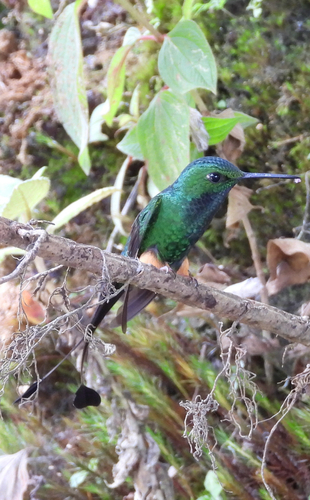
Rufous-booted Racket-tail
Ocreatus addae
All racket-tails have pronounced sexual dimorphism. Only the male has elongated outer rectrices (tail feathers) that have bare shafts with terminal flags. On both the annae and addae racket-tails, those feathers are decurved and cross; the flags are asymmetric ellipses. Male rufous-booted racket-tails are 11 to 15 cm (4.3 to 5.9 in) long including the 5.5 to 6 cm (2.2 to 2.4 in) long outer tail feathers, and weigh 2.5 to 2.7 g (0.088 to 0.095 oz). Females are 7.6 to 9 cm (3.0 to 3.5 in) long and weigh 2.6 to 3.2 g (0.092 to 0.11 oz). Voice: Both male and female rufous-booted racket-tails give "a diagnostic, descending, thin sweet trill, 'ti-tlee-ee-ee' single 'tsit' and 'trrt' notes."
ID text from Wikipedia, CC BY-SA 4.0
Where you might meet both
Learn this pair in the BeakBrain App
Photo and call practice. Coming soon to iPhone and Android.
Play today's Daily BirdPhotos and recordings are credited to their authors under the licence shown. Full profiles: Peruvian Racket-tail and Rufous-booted Racket-tail.