Learn what every symbol on the card means.Full credits and sources at beakbrain.com/symbols
 MarineScrapeHuge · 3.4 kg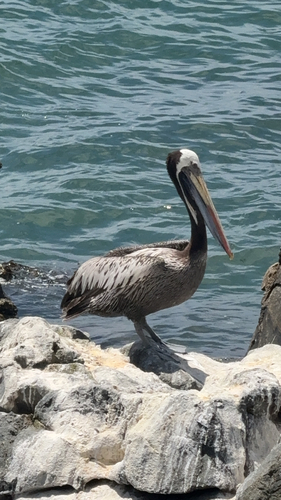








ID tip
These birds are dark in colour with a white stripe from the top of the bill up to the crown and down the sides of the neck. They have long tufted feathers on the top of their heads. It was previously considered a subspecies of the brown pelican (Pelecanus occidentalis). The Peruvian pelican is considerably larger, ranging from about 5 to 7 kg (11–15 lb) in weight, 137 to 152 cm (4.5–5.0 ft) in length and with a wingspan of about 228 cm (7.5 ft).
Text from Wikipedia, licensed CC BY-SA 4.0.
When to see the Peruvian Pelican
One bar for each month, and every month is filled: this bird is recorded here in all twelve. The wide bar is October, the month with the most records.
Where to see the Peruvian Pelican
The map shades 3 countries with regular records, and 1 more in a lighter tone where the bird turns up only as a stray. Everything unshaded has no records. Countries are listed below the map.
Recorded as a rare visitor in El Salvador.
About the Peruvian Pelican
The Peruvian pelican is a member of the pelican family. It lives on the west coast of South America, breeding in loose colonies from about 33.5 degrees south in central Chile to Piura in northern Peru, and occurring as a visitor in southern Chile and Ecuador. It used to be considered a subspecies of the brown pelican.
Text adapted from Wikipedia, licensed CC BY-SA 4.0.
Easily confused with
 Spot-billed PelicanPelecanus philippensisThe spot-billed pelican is a rather large water bird, often the largest or one of the largest native birds in the southern stretches of its range, albeit it is fairly small for a pelican.
 Great White PelicanPelecanus onocrotalusThe great white pelican is a huge bird—only the Dalmatian pelican is, on average, larger among pelicans.
 Dalmatian PelicanPelecanus crispusThe Dalmatian pelican is the largest of all pelican species and one of the heaviest flying birds in the world, with a body length of 1.6–1.8 m (5 ft 3 in – 5 ft 11 in), a wingspan typically ranging between 2.7–3.2 m (8 ft 10 in – 10 ft 6 in)., and an average weight of about 9.5 kg (21 lb).
Side by side: Australian Pelican vs Peruvian Pelican · Great White Pelican vs Peruvian Pelican · Peruvian Pelican vs Spot-billed Pelican · Dalmatian Pelican vs Peruvian Pelican · Peruvian Pelican vs Pink-backed Pelican
Learn the Peruvian Pelican in the BeakBrain App
Photo and call practice. Coming soon to iPhone and Android.
Play today's Daily BirdEvery photo and recording on this page is credited to its author under the licence shown. Spotted a problem with this page, or have a better photo? Contribute.