Learn what every symbol on the card means.Full credits and sources at beakbrain.com/symbols
 ShrublandCup nestSmall · 20 g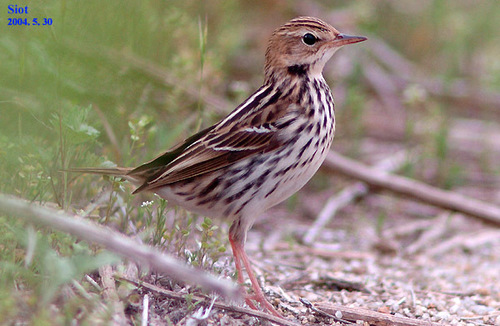


ID tip
A. gustavi is a small pipit, which somewhat resembles non-breeding red-throated pipit in plumage. It is heavily streaked brown above, with whitish mantle stripes, and with black markings on a white belly and buff breast below. It can be distinguished from red-throated pipit by its heavier bill, whiter mantle stripes, and contrast between its buff breast and white belly. This species creeps in long grass, and is reluctant to fly even when disturbed. Its call is a distinctive electrical zip. Although the call is generally helpful when identifying pipits, this species calls far less than most.
Text from Wikipedia, licensed CC BY-SA 4.0.
When to see the Pechora Pipit
One bar for each month. Filled bars are the 5 months with records; pale bars are months with none. The wide bar is October, the month with the most records.
Where to see the Pechora Pipit
The map shades 8 countries with regular records, and 8 more in a lighter tone where the bird turns up only as a stray. Everything unshaded has no records. Countries are listed below the map.
Recorded as a rare visitor in United States, United Kingdom, Norway, France, Japan, Mongolia, Sweden, Australia.
About the Pechora Pipit
The Pechora pipit is a small passerine bird which breeds in the East Palearctic tundra and densely vegetated areas near river banks ranges from the Pechora River to the Chukchi Peninsula. It also breeds in Kamchatka and the Commander Islands, and with a disjunct population much further south in northeastern China and southeastern Siberia. It is a long-distance migrant, moving in winter to Indonesia. Rarely in September and October, the Pechora pipit may be observed in western Europe. The species was first described by Robert Swinhoe in 1863.
Text adapted from Wikipedia, licensed CC BY-SA 4.0.
Easily confused with
 Peruvian PipitAnthus peruvianusThe Peruvian pipit is one of the smallest members of genus Anthus.
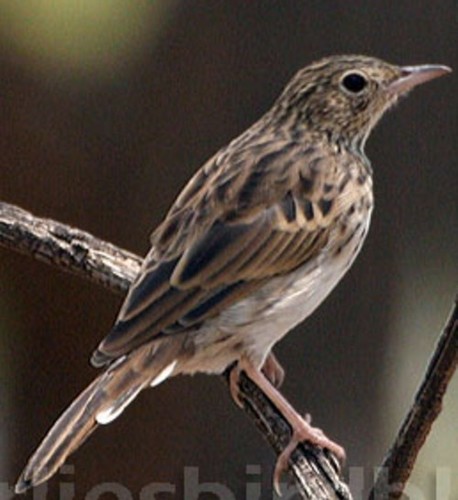 Bushveld PipitAnthus cafferThe bushveld pipit, also known as bush pipit or little pipit, is a species of bird in the pipit and wagtail family Motacillidae.
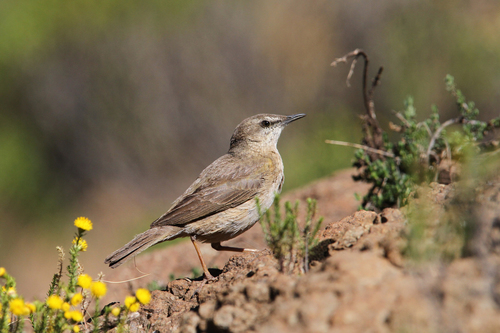 African Rock PipitAnthus crenatusThe yellow-tufted pipit is identified in the field by its brown and gray feathers.
Side by side: Paramo Pipit vs Pechora Pipit · African Rock Pipit vs Pechora Pipit · Pechora Pipit vs Peruvian Pipit
Learn the Pechora Pipit in the BeakBrain App
Photo and call practice. Coming soon to iPhone and Android.
Play today's Daily BirdEvery photo and recording on this page is credited to its author under the licence shown. Spotted a problem with this page, or have a better photo? Contribute.