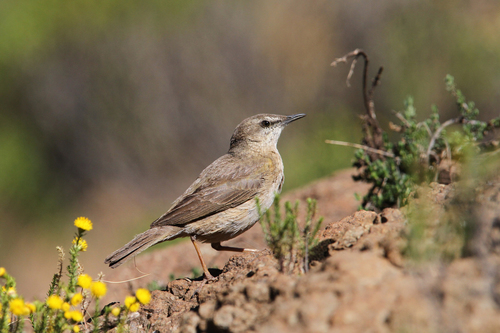
African Rock Pipit
Anthus crenatus
The yellow-tufted pipit is identified in the field by its brown and gray feathers. The species is further recognized by the marks of yellow on the stomach and wings. Its grayish, white eyebrow allows the yellow-tufted pipit to be spotted within the varying genera. The pipit has a dark brown beak and light brown, petite legs. The bird ranges in size from 17–18 centimeters (6.7–7.0 inches) and 29–32.5 grams (1.0–1.1 ounces). The species is sexually monomorphic.
ID text from Wikipedia, CC BY-SA 4.0
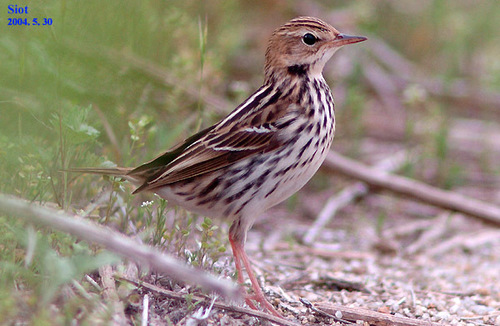
Pechora Pipit
Anthus gustavi
A. gustavi is a small pipit, which somewhat resembles non-breeding red-throated pipit in plumage. It is heavily streaked brown above, with whitish mantle stripes, and with black markings on a white belly and buff breast below. It can be distinguished from red-throated pipit by its heavier bill, whiter mantle stripes, and contrast between its buff breast and white belly. This species creeps in long grass, and is reluctant to fly even when disturbed. Its call is a distinctive electrical zip. Although the call is generally helpful when identifying pipits, this species calls far less than most.
ID text from Wikipedia, CC BY-SA 4.0
Learn this pair in the BeakBrain App
Photo and call practice. Coming soon to iPhone and Android.
Play today's Daily BirdPhotos and recordings are credited to their authors under the licence shown. Full profiles: African Rock Pipit and Pechora Pipit.