Learn what every symbol on the card means.Full credits and sources at beakbrain.com/symbols
 ForestCavity nestMedium · 75 g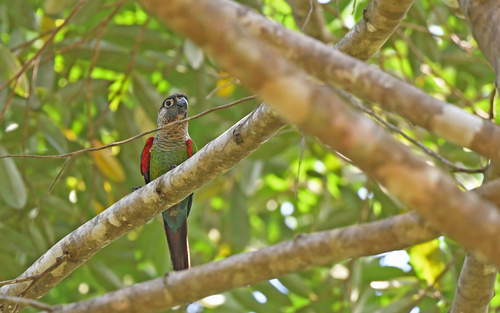
ID tip
The pearly parakeet is 24 to 25 cm (9.4 to 9.8 in) long and weighs 70 to 80 g (2.5 to 2.8 oz). The sexes are the same. Adults of the nominate subspecies have a dark brown crown and buff ear coverts; the rest of their face is dull blue-green with whitish bare skin around the eye. Their upperparts are green with a bluish tinge. Their upper breast and the sides of their neck are brown with buff scaling; the breast has a blue tinge. The rest of their underparts are green with a blue wash. Their wing is mostly green, with black and cobalt blue primaries and red underwing coverts. Voice: The pearly parakeet's calls "possess a rather grating quality, the notes usually given in fast series, e.g. "krree krree krree" or "krek krek krek" " and are given both from a perch and in flight. However, perched birds are often silent. Flocks in flight "call frequently and simultaneously, producing a noisy, harsh and piercing chattering."
Text from Wikipedia, licensed CC BY-SA 4.0.
When to see the Pearly Parakeet
One bar for each month. Filled bars are the 9 months with records; pale bars are months with none. The wide bar is August, the month with the most records.
Where to see the Pearly Parakeet
The map shades 1 country with regular records. Everything unshaded has no records. Countries are listed below the map.
About the Pearly Parakeet
The pearly parakeet, known as the pearly conure in aviculture, is a Vulnerable species in subfamily Arinae of the family Psittacidae, the African and New World parrots. It is endemic to Brazil.
Text adapted from Wikipedia, licensed CC BY-SA 4.0.
Easily confused with
 Pfrimer's ParakeetPyrrhura pfrimeriPfrimer's parakeet is a non-migratory species within the parrot family Psittacidae.
 El Oro ParakeetPyrrhura orcesiThe El Oro parakeet is 22 to 24 cm (8.7 to 9.4 in) long and weighs 65 to 75 g (2.3 to 2.6 oz).
Learn the Pearly Parakeet in the BeakBrain App
Photo and call practice. Coming soon to iPhone and Android.
Play today's Daily BirdEvery photo and recording on this page is credited to its author under the licence shown. Spotted a problem with this page, or have a better photo? Contribute.