Learn what every symbol on the card means.Full credits and sources at beakbrain.com/symbols
 ForestCavity nestMedium · 76 g
When to see the Pfrimer's Parakeet
One bar for each month. Filled bars are the 10 months with records; pale bars are months with none. The wide bar is November, the month with the most records.
Where to see the Pfrimer's Parakeet
The map shades 1 country with regular records. Everything unshaded has no records. Countries are listed below the map.
About the Pfrimer's Parakeet
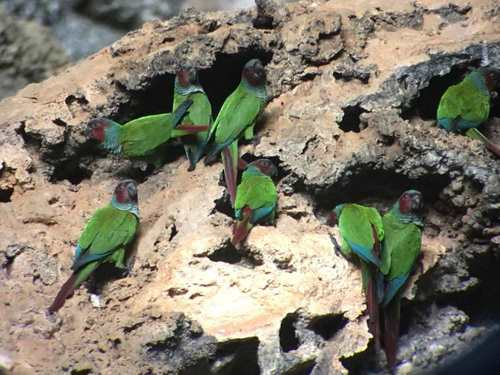
Pfrimer's parakeet is a non-migratory species within the parrot family Psittacidae. It also is known as Pfrimer's conure, Goias parakeet, and maroon-faced conure. The Pfrimer's parakeet has been qualified as endangered by the IUCN and BirdLife International since 2007. It is endemic to the Goiás and Tocantins regions of Brazil. It is mainly found within a belt of dry deciduous and semi-deciduous areas of the Caatinga forest.
Text adapted from Wikipedia, licensed CC BY-SA 4.0.
Easily confused with
 Perija ParakeetPyrrhura caeruleicepsThe Perija parakeet, also known as Todd's parakeet or in aviculture as Perijá conure, is a species of parrot in the family Psittacidae.
 Rose-fronted ParakeetPyrrhura roseifronsThe rose-fronted parakeet is 20 to 23 cm (7.9 to 9.1 in) long.
Venezuelan ParakeetPyrrhura emmaThe Venezuelan parakeet is 22 to 23 cm (8.7 to 9.1 in) long.
Rose-fronted ParakeetPyrrhura roseifronsThe rose-fronted parakeet is 20 to 23 cm (7.9 to 9.1 in) long.
Venezuelan ParakeetPyrrhura emmaThe Venezuelan parakeet is 22 to 23 cm (8.7 to 9.1 in) long.
Learn the Pfrimer's Parakeet in the BeakBrain App
Photo and call practice. Coming soon to iPhone and Android.
Play today's Daily BirdEvery photo and recording on this page is credited to its author under the licence shown. Spotted a problem with this page, or have a better photo? Contribute.