Learn what every symbol on the card means.Full credits and sources at beakbrain.com/symbols
 GrasslandPlatform nestLarge · 384 g


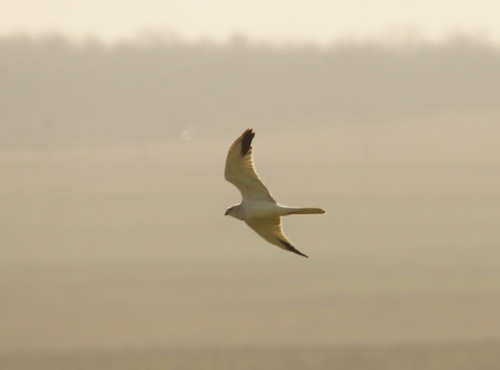
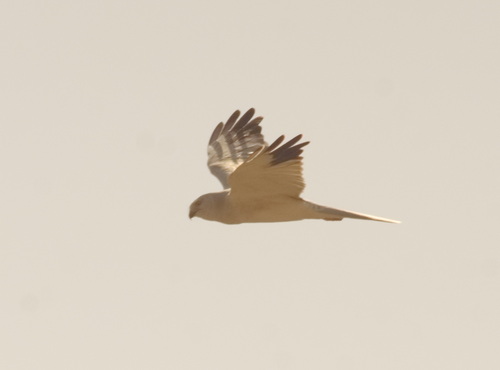
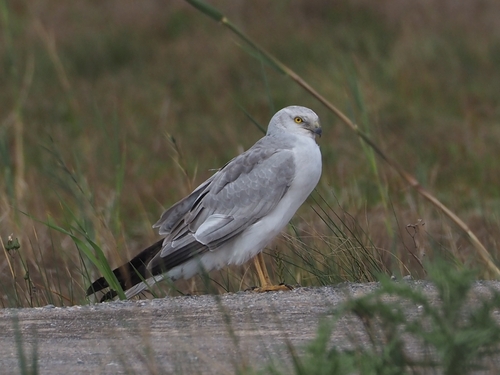
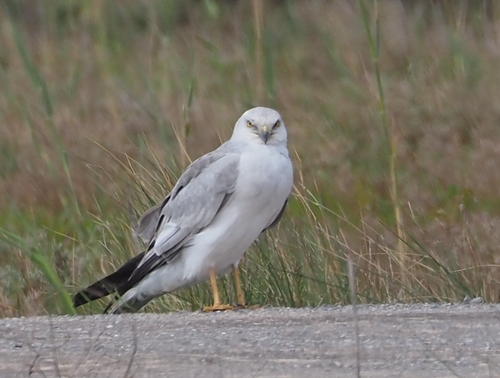
ID tip
This is a typical harrier, with long wings held in a shallow V in its low flight. It also resembles other harriers in having distinct male and female plumages. Adults measure 40–48 cm (16–19 in) long with a wingspan of 95–120 cm (37–47 in). Males weigh 315 g (11.1 oz) while the slightly larger females weigh 445 g (15.7 oz). The male is whitish grey above and white below, with narrow black wingtips. It differs from the hen harrier in its smaller size, narrower wings, paler colour, and different wing tip pattern.
Text from Wikipedia, licensed CC BY-SA 4.0.
When to see the Pallid Harrier
One bar for each month. Filled bars are the 10 months with records; pale bars are months with none. The wide bar is September, the month with the most records.
Where to see the Pallid Harrier
The map shades 97 countries with regular records, and 9 more in a lighter tone where the bird turns up only as a stray. Everything unshaded has no records. Countries are listed below the map.
Recorded as a rare visitor in Morocco, Iceland, Togo, North Macedonia, Angola, Somalia, Afghanistan, Tajikistan, Luxembourg.
About the Pallid Harrier
The pallid harrier is a species of harrier, a bird of prey in the family Accipitridae. It breeds in southern parts of eastern Europe and central Asia and Iran and winters mainly in India and southeast Asia. It is a rare but increasing vagrant to Great Britain and western Europe. In 2017 a pair of pallid harriers nested in a barley field in the Netherlands; they raised four chicks, the first recording breeding of the species in the country. In 2019, a pair bred in Spain for the first time.
Text adapted from Wikipedia, licensed CC BY-SA 4.0.
Easily confused with
 Eastern Marsh HarrierCircus spilonotusIt is 48 to 58 cm long with a wingspan of 113 to 137 cm; like most birds of prey, the female is usually larger than the male.
 Long-winged HarrierCircus buffoniThe long-winged is mid-sized bird of prey, and like most birds of prey species, the females are larger than the males.
 Cinereous HarrierCircus cinereusThe male's plumage is dark grey above with black wingtips and a white rump.
Side by side: Montagu's Harrier vs Pallid Harrier · Pallid Harrier vs Swamp Harrier · Eastern Marsh Harrier vs Pallid Harrier · Long-winged Harrier vs Pallid Harrier · Cinereous Harrier vs Pallid Harrier
Learn the Pallid Harrier in the BeakBrain App
Photo and call practice. Coming soon to iPhone and Android.
Play today's Daily BirdEvery photo and recording on this page is credited to its author under the licence shown. Spotted a problem with this page, or have a better photo? Contribute.