Learn what every symbol on the card means.Full credits and sources at beakbrain.com/symbols
 WoodlandCup nestSmall · 38 g


ID tip
The palila has a yellow head and breast, with white to light gray plumage ventrally, medium gray plumage dorsally, and olive-green wings and tail. The bird also has a heavy dark bill with swollen sides, a brown iris, and dark feet with yellowish soles. The palila is one of the largest living Hawaiian honeycreepers, measuring around 6–7.5 inches (15–19 cm). With a body mass of 38.1 g (1.34 oz) on average in males and 37.6 g (1.33 oz), it appears to be the heaviest Hawaiian honeycreeper. There is some sexual dimorphism.
Text from Wikipedia, licensed CC BY-SA 4.0.
When to see the Palila
One bar for each month. Filled bars are the 11 months with records; pale bars are months with none. The wide bar is February, the month with the most records.
About the Palila
The palila is a critically endangered finch-billed species of Hawaiian honeycreeper. It has a golden-yellow head and breast, with a light belly, gray back, and greenish wings and tail. The bird has a close ecological relationship with the māmane tree, and became endangered due to destruction of the trees and accompanying dry forests. The first specimen of the palila was collected in 1876 at the Greenwell Ranch on the Big Island by Pierre Étienne Théodore Ballieu (1828–1885), who was French consul in Hawaiʻi from 1869 to 1878. The type specimen is housed at the Muséum national d'histoire naturelle in Paris.
Text adapted from Wikipedia, licensed CC BY-SA 4.0.
Easily confused with
 Antillean SiskinSpinus dominicensisThe Antillean siskin is 11 to 12 cm (4.3 to 4.7 in) long and weighs about 9 g (0.3 oz).
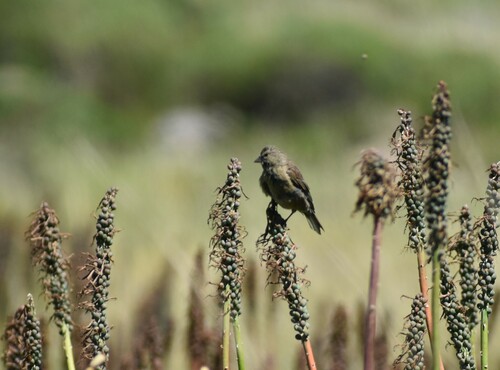 Drakensberg SiskinCrithagra symonsiThe Drakensberg siskin averages 13–14 cm in length.
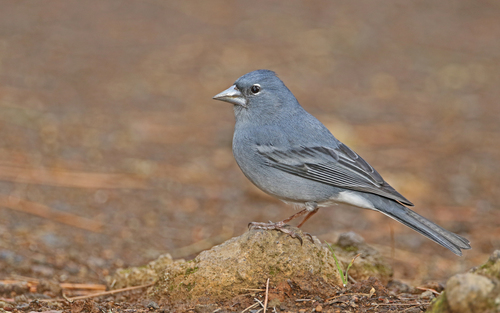 Tenerife Blue ChaffinchFringilla teydeaTenerife blue chaffinches resemble common chaffinches, but they are noticeably larger, and have a thicker bill.
Learn the Palila in the BeakBrain App
Photo and call practice. Coming soon to iPhone and Android.
Play today's Daily BirdEvery photo and recording on this page is credited to its author under the licence shown. Spotted a problem with this page, or have a better photo? Contribute.