Learn what every symbol on the card means.Full credits and sources at beakbrain.com/symbols
 GrasslandScrapeMedium · 287 g

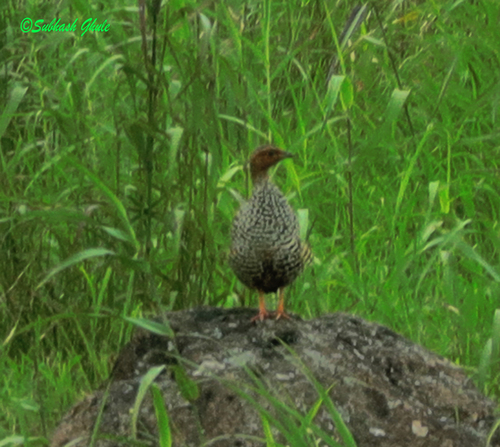
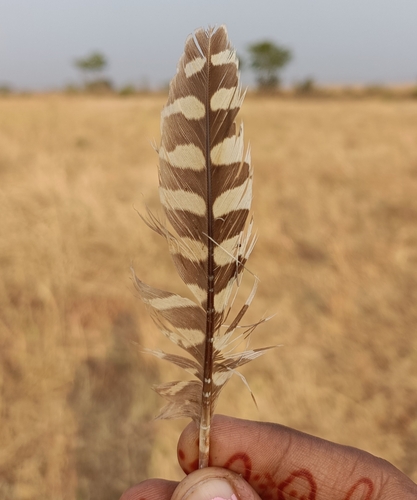
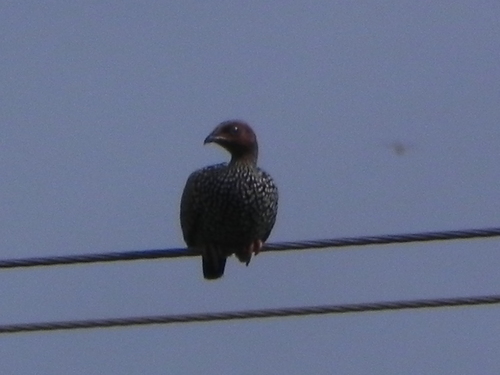
ID tip
This species is endemic to the Indian subcontinent. It is distributed patchily from Rajasthan and Uttar Pradesh south into peninsular India (but not along the Malabar coast and rare south of Coimbatore) and in Sri Lanka. The species interbreeds with the black francolin along its northern and appears similar to the female of that species but has no rufous hindcollar, instead having a bright rufous face and throat. The underside has white spots while the legs are orange-yellow to red. It is more arboreal in its habits than the black francolin. The legs of both sexes have no spurs.
Text from Wikipedia, licensed CC BY-SA 4.0.
When to see the Painted Francolin
One bar for each month. Filled bars are the 7 months with records; pale bars are months with none. The wide bar is September, the month with the most records.
Where to see the Painted Francolin
The map shades 2 countries with regular records, and 1 more in a lighter tone where the bird turns up only as a stray. Everything unshaded has no records. Countries are listed below the map.
Recorded as a rare visitor in Bangladesh.
About the Painted Francolin
The painted francolin or painted partridge is a species of francolin found in grassy areas in central and southern India and in the lowlands of southeastern Sri Lanka. Thomas C. Jerdon noted that the species was found mainly in Central India south of the Narmada and to the east of the Western Ghats as well as the Chota Nagpur and Northern Circars. It partly overlaps with the black francolin with which it partly overlaps and is said to sometimes hybridize. This species can be so distinguished from a black francolin female by the lack of a rufous hind collar and the white spots on the underside. The face is rufous and there is no dark stripe running behind the eye.
Text adapted from Wikipedia, licensed CC BY-SA 4.0.
Easily confused with
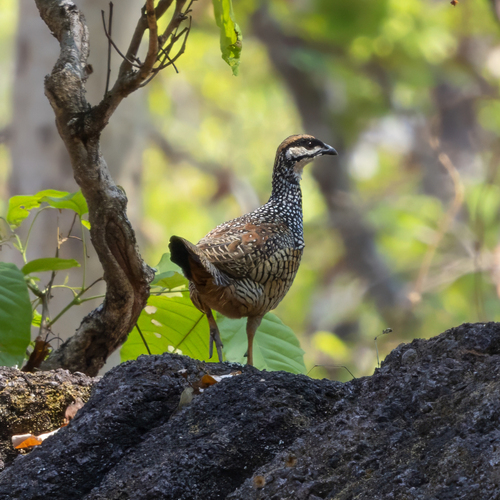 Chinese FrancolinFrancolinus pintadeanusOn average, the length of the bird is 30–34 cm (12–13 in) and it weighs 280–400 g (9.9–14.1 oz).
 Black FrancolinFrancolinus francolinusThe black francolin has a length range around 33 to 36 cm (13 to 14 in) and weight about 453 g (16.0 oz).
Side by side: Black Francolin vs Painted Francolin · Chinese Francolin vs Painted Francolin
Learn the Painted Francolin in the BeakBrain App
Photo and call practice. Coming soon to iPhone and Android.
Play today's Daily BirdEvery photo and recording on this page is credited to its author under the licence shown. Spotted a problem with this page, or have a better photo? Contribute.