Learn what every symbol on the card means.Full credits and sources at beakbrain.com/symbols
 GrasslandScrapeMedium · 75 g




What the Oriental Pratincole sounds like

ID tip
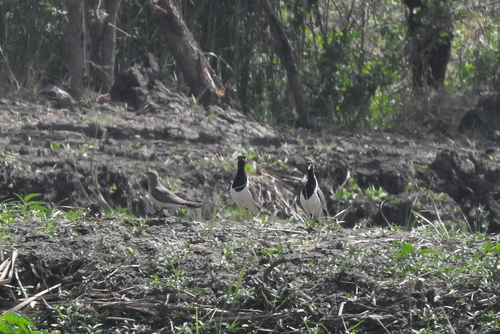
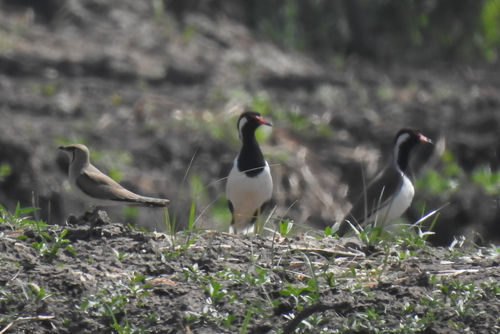
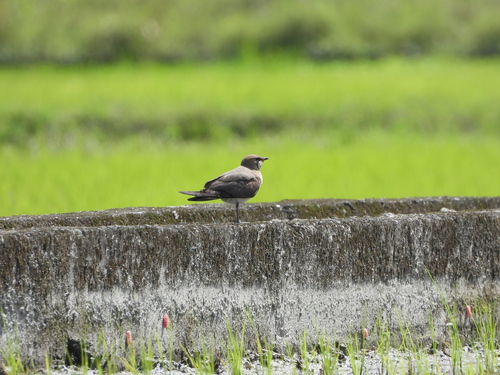
The Oriental pratincole has short legs, long pointed wings and long forked tails. It has a short bill, which is an adaptation to aerial feeding. The back and head are brown, and the wings are brown with black flight feathers. The belly is white and the underwings are chestnut. Very good views are needed to distinguish the species from other pratincoles, particularly the very similar collared pratincole, which also has a chestnut underwing. The black-winged pratincole shares the black upperwing flight feathers, and lacks a white trailing edge to the wing.
Text from Wikipedia, licensed CC BY-SA 4.0.
When to see the Oriental Pratincole
One bar for each month. Filled bars are the 10 months with records; pale bars are months with none. The wide bar is April, the month with the most records.
Where to see the Oriental Pratincole
The map shades 32 countries with regular records, and 12 more in a lighter tone where the bird turns up only as a stray. Everything unshaded has no records. Countries are listed below the map.
Recorded as a rare visitor in United Kingdom, Norway, Germany, United States, Denmark, Netherlands, Finland, Russia, Réunion, Bhutan, Israel, New Zealand.
About the Oriental Pratincole
The oriental pratincole, also known as the grasshopper-bird or swallow-plover, is a wader in the pratincole family, Glareolidae.
Text adapted from Wikipedia, licensed CC BY-SA 4.0.
Easily confused with
 Collared PratincoleGlareola pratincolaThis pratincole is 24–28 cm (9.4–11.0 in) long with a 60–70 cm (24–28 in) wingspan.
 Small PratincoleGlareola lacteaThis bird has short legs, long pointed wings and a short tail.
 Australian PratincoleGlareola isabellaThe Australian pratincole is a medium-sized slender shorebird with long legs, long pointed wings and a short decurved bill.
Side by side: Collared Pratincole vs Oriental Pratincole · Oriental Pratincole vs Small Pratincole · Australian Pratincole vs Oriental Pratincole
Learn the Oriental Pratincole in the BeakBrain App
Photo and call practice. Coming soon to iPhone and Android.
Play today's Daily BirdEvery photo and recording on this page is credited to its author under the licence shown. Spotted a problem with this page, or have a better photo? Contribute.