Learn what every symbol on the card means.Full credits and sources at beakbrain.com/symbols
 MarinePlatform nestHuge · 3.0 kg




What the Northern Gannet sounds like


ID tip
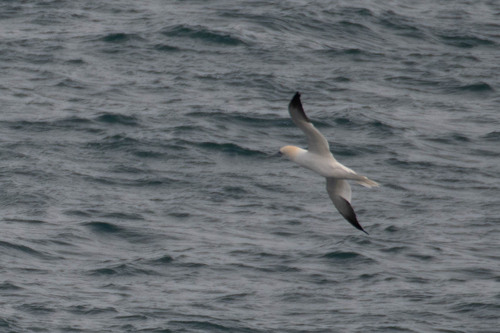
An adult northern gannet has a 170–180 cm (67–71 in) wingspan, and is 87–100 cm (34+1⁄2–39+1⁄2 in) long and weighs 2.3–3.6 kg (5–8 lb), making it the largest gannet and the largest seabird native to the western Palearctic. The two sexes are generally of a similar size and appearance. The plumage is white with dark brown to black wing tips; the primary flight feathers, primary coverts and alulae are dark. The head and neck are tinged buff-yellow, becoming much more prominent in the breeding season. Males are more deeply coloured than females. Voice: The northern gannet is a loud and vocal bird, particularly in the colony. Its typical call is a harsh arrah-arrah or urrah-urrah, which is emitted upon arriving or when challenging other gannets at the colony. The call is shortened to a rah rah when fishing or collecting nesting material, and lengthened to a ooo-ah when taking off. The calls of the sexes are similar.
Text from Wikipedia, licensed CC BY-SA 4.0.
When to see the Northern Gannet
One bar for each month, and every month is filled: this bird is recorded here in all twelve. The wide bar is July, the month with the most records.
Where to see the Northern Gannet
The map shades 42 countries with regular records, and 5 more in a lighter tone where the bird turns up only as a stray. Everything unshaded has no records. Countries are listed below the map.
Recorded as a rare visitor in Mexico, Finland, Switzerland, Martinique, Slovenia.
About the Northern Gannet
The Northern gannet is a seabird, the largest species of the gannet family, Sulidae. It is native to the coasts of the North Atlantic Ocean, breeding in Western Europe and Northeastern North America. It is the largest seabird in the northern Atlantic. The sexes are similar in appearance. The adult northern gannet has a mainly white streamlined body with a long neck, and long and slender wings. It is 87–100 cm long with a 170–180 cm (67–71 in) wingspan. The head and nape have a buff tinge that is more prominent in breeding season, and the wings are edged with dark brown-black feathers. The long, pointed bill is blue-grey, contrasting with black, bare skin around the mouth and eyes.
Text adapted from Wikipedia, licensed CC BY-SA 4.0.
Easily confused with
 Cape GannetMorus capensisWhen seen in flight the snow-white body with the black tail, primaries and secondaries, and dark bill makes them easy to identify.
 Australasian GannetMorus serratorAn adult Australasian gannet is 84–91 cm (33–36 in) long, weighs 2.3 kg (5.1 lb), and has a 170–200 cm (67–79 in) wingspan.
Side by side: Cape Gannet vs Northern Gannet · Australasian Gannet vs Northern Gannet
Learn the Northern Gannet in the BeakBrain App
Photo and call practice. Coming soon to iPhone and Android.
Play today's Daily BirdEvery photo and recording on this page is credited to its author under the licence shown. Spotted a problem with this page, or have a better photo? Contribute.