Learn what every symbol on the card means.Full credits and sources at beakbrain.com/symbols
 MarineScrapeHuge · 2.6 kg


ID tip
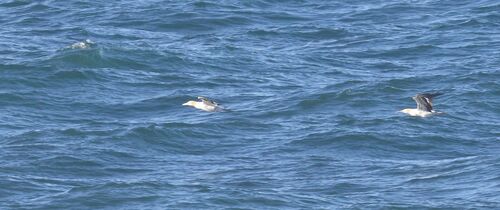
When seen in flight the snow-white body with the black tail, primaries and secondaries, and dark bill makes them easy to identify. At closer range the distinctive golden crown and nape, which gradually becomes white on the neck, is noticeable. Juveniles and immatures are dark brown with a pale bill, and can resemble the dark-coloured boobies at first glance. Adults are about 84–94 cm (33–37 in) long and have a 171–185 cm (67–73 in) wingspan and weigh ca. 2.6 kg (5.7 lb).
Text from Wikipedia, licensed CC BY-SA 4.0.
When to see the Cape Gannet
One bar for each month. Filled bars are the 4 months with records; pale bars are months with none. The wide bar is January, the month with the most records.
Where to see the Cape Gannet
The map shades 6 countries with regular records. Everything unshaded has no records. Countries are listed below the map.
About the Cape Gannet
The Cape gannet is a large seabird of the gannet family, Sulidae.
Text adapted from Wikipedia, licensed CC BY-SA 4.0.
Easily confused with
 Australasian GannetMorus serratorAn adult Australasian gannet is 84–91 cm (33–36 in) long, weighs 2.3 kg (5.1 lb), and has a 170–200 cm (67–79 in) wingspan.
 Northern GannetMorus bassanusAn adult northern gannet has a 170–180 cm (67–71 in) wingspan, and is 87–100 cm (34+1⁄2–39+1⁄2 in) long and weighs 2.3–3.6 kg (5–8 lb), making it the largest gannet and the largest seabird native to the western Palearctic.
Side by side: Cape Gannet vs Northern Gannet · Australasian Gannet vs Cape Gannet
Learn the Cape Gannet in the BeakBrain App
Photo and call practice. Coming soon to iPhone and Android.
Play today's Daily BirdEvery photo and recording on this page is credited to its author under the licence shown. Spotted a problem with this page, or have a better photo? Contribute.