Learn what every symbol on the card means.Full credits and sources at beakbrain.com/symbols
 ForestCavity nestMedium · 67 g


What the Northern Barred Woodcreeper sounds like


ID tip
The northern barred woodcreeper is one of the larger members of its subfamily. It is slim, with a long tail, a medium-length straight bill, and (in the male) a shaggy crest. It is 25 to 29 cm (9.8 to 11 in) long. Males weigh 53 to 72 g (1.9 to 2.5 oz) and females 54 to 83 g (1.9 to 2.9 oz). The sexes have the same plumage. Adults of the nominate subspecies D. s. sanctithomae have a mostly cinnamon-brown face with fine barring, a faint rufous supercilium, black lores, and a rich rufescent forehead, crown, and nape. Voice: The northern barred woodcreeper mostly sings at dawn and dusk but also intermittently during the day. The song of the "western" three subspecies is a series of loud whistles that rise at the end. It is variously put in words as "téw-wee, téw-wee, téw-weea", a "slightly nasal pwee-PWEE-PWEE-PWEE-peeeurr", "a penetrating doh-wee, doh-wee, doh-wee, do-wee", and "oowít, oowít, oowít, OOWIT, OOWIT!".
Text from Wikipedia, licensed CC BY-SA 4.0.
When to see the Northern Barred Woodcreeper
One bar for each month, and every month is filled: this bird is recorded here in all twelve. The wide bar is March, the month with the most records.
Where to see the Northern Barred Woodcreeper
The map shades 10 countries with regular records, and 1 more in a lighter tone where the bird turns up only as a stray. Everything unshaded has no records. Countries are listed below the map.
Recorded as a rare visitor in Venezuela.
About the Northern Barred Woodcreeper
The northern barred woodcreeper is a sub-oscine passerine bird in subfamily Dendrocolaptinae of the ovenbird family Furnariidae. It is found from southern Mexico through Central America to Colombia, Venezuela and Ecuador.
Text adapted from Wikipedia, licensed CC BY-SA 4.0.
Easily confused with
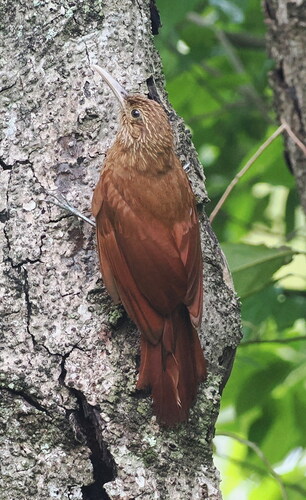
 Planalto WoodcreeperDendrocolaptes platyrostrisThe planalto woodcreeper is one of the larger members of its subfamily.
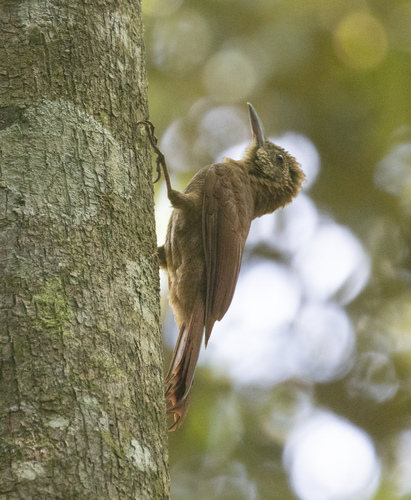
 Black-banded WoodcreeperDendrocolaptes picumnusThe black-banded woodcreeper is one of the larger members of its subfamily.
 Amazonian Barred WoodcreeperDendrocolaptes certhiaThe Amazonian barred woodcreeper is one of the larger members of its subfamily.
Side by side: Northern Barred Woodcreeper vs Planalto Woodcreeper · Black-banded Woodcreeper vs Northern Barred Woodcreeper · Amazonian Barred Woodcreeper vs Northern Barred Woodcreeper
Learn the Northern Barred Woodcreeper in the BeakBrain App
Photo and call practice. Coming soon to iPhone and Android.
Play today's Daily BirdEvery photo and recording on this page is credited to its author under the licence shown. Spotted a problem with this page, or have a better photo? Contribute.