Learn what every symbol on the card means.Full credits and sources at beakbrain.com/symbols
 ForestCavity nestMedium · 77 g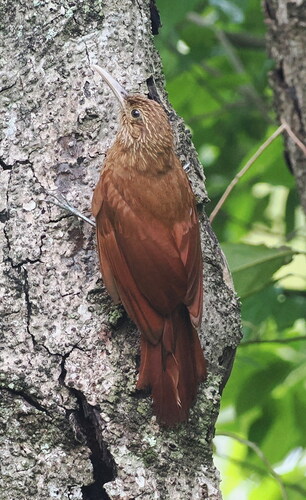
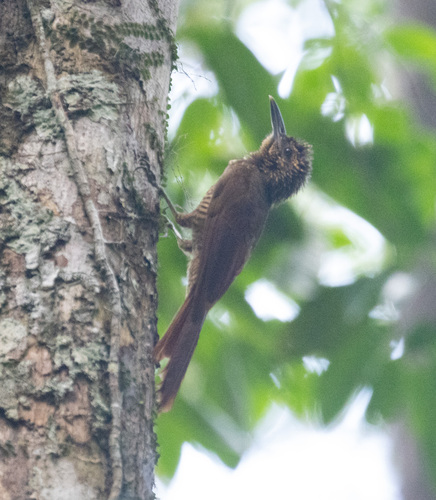
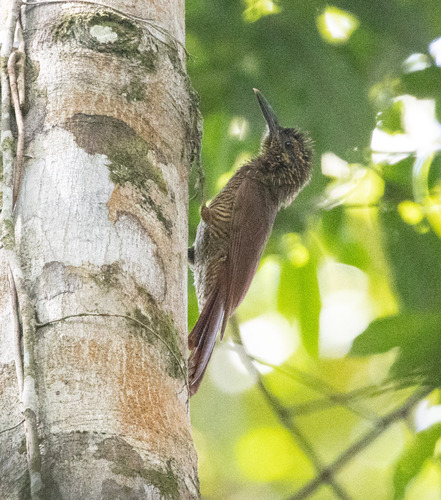
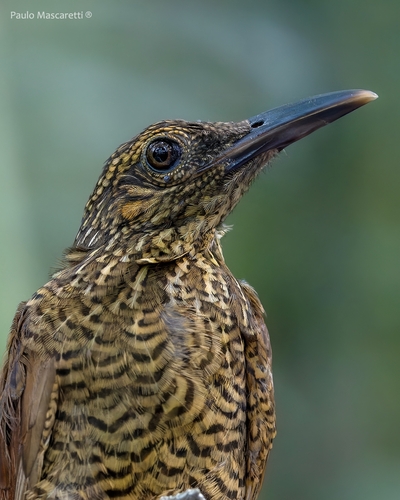
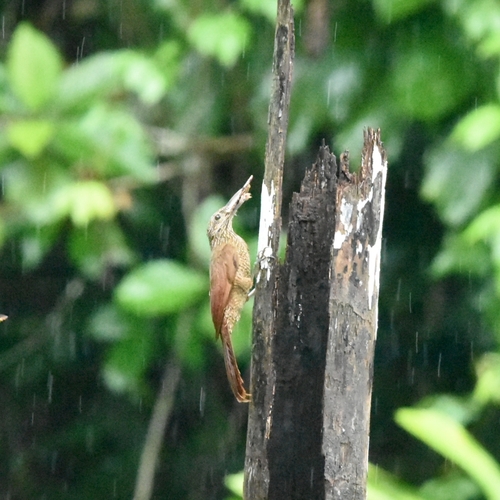
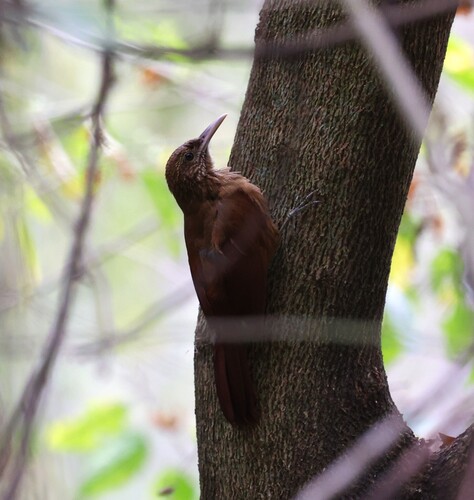
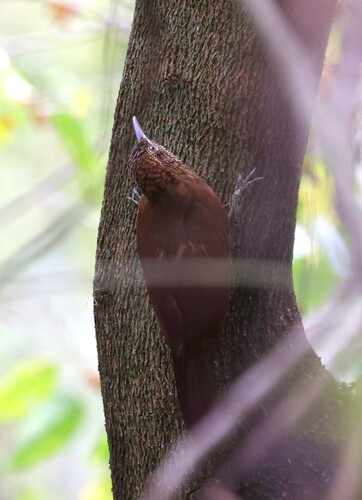
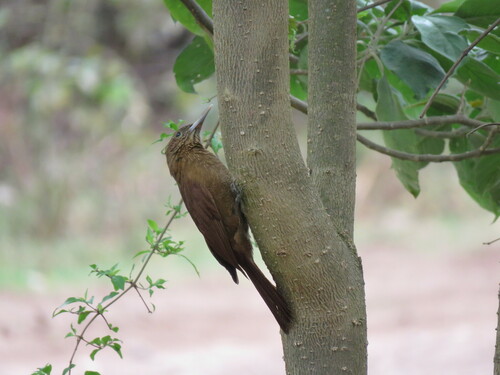

What the Black-banded Woodcreeper sounds like


ID tip
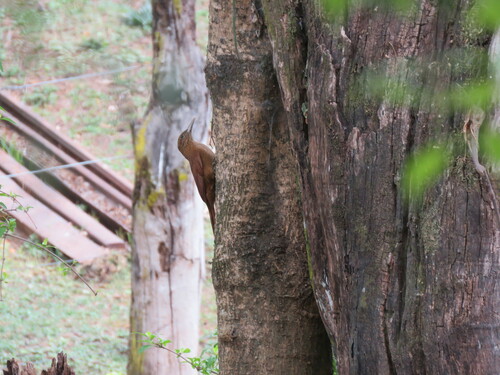
The black-banded woodcreeper is one of the larger members of its subfamily. It is slim, with a long tail and a medium-length straight bill. It is 24 to 30.5 cm (9.4 to 12 in) long. Males weigh 47 to 89 g (1.7 to 3.1 oz) and females 48 to 98 g (1.7 to 3.5 oz). The sexes have the same plumage. Adults of the nominate subspecies D. p. picumnus have a dusky face and neck with buffy to tawny streaks and a faint supercilium and eyering. Their forehead, crown, and nape are dark brown; the crown and nape have buff to tawny streaks. Voice: The black-banded woodcreeper sings mostly at dawn and dusk, and only rarely during the day. Birds in Amazonia sing "a loud series...of 15–20 rapidly delivered liquid notes, usually on same pitch, sometimes falling away at end, 'kie-ie-ie--…ie-ee-eu-eu-er', 'glü glü glü glü glü' or 'whi-whi-whiwhiwhi'." Those in Mexico sing a "high-pitched, descending chatter".
Text from Wikipedia, licensed CC BY-SA 4.0.
When to see the Black-banded Woodcreeper
One bar for each month, and every month is filled: this bird is recorded here in all twelve. The wide bar is July, the month with the most records.
Where to see the Black-banded Woodcreeper
The map shades 16 countries with regular records, and 2 more in a lighter tone where the bird turns up only as a stray. Everything unshaded has no records. Countries are listed below the map.
About the Black-banded Woodcreeper
The black-banded woodcreeper is a sub-oscine passerine bird in subfamily Dendrocolaptinae of the ovenbird family Furnariidae. It is found discontinuously from Chiapas, Mexico, to Panama and in every mainland South American country except Chile and Uruguay.
Text adapted from Wikipedia, licensed CC BY-SA 4.0.
Easily confused with
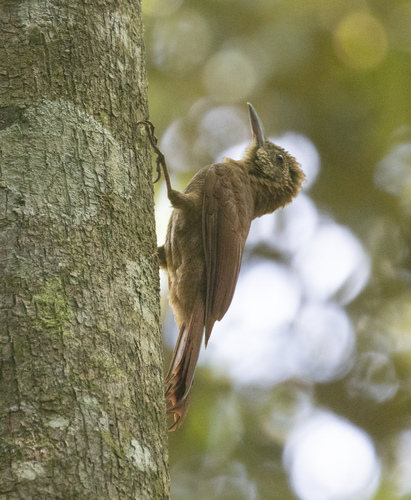 Amazonian Barred WoodcreeperDendrocolaptes certhiaThe Amazonian barred woodcreeper is one of the larger members of its subfamily.
 Planalto WoodcreeperDendrocolaptes platyrostrisThe planalto woodcreeper is one of the larger members of its subfamily.
Hoffmanns's WoodcreeperDendrocolaptes hoffmannsiHoffmanns's woodcreeper is one of the larger members of its subfamily.
Planalto WoodcreeperDendrocolaptes platyrostrisThe planalto woodcreeper is one of the larger members of its subfamily.
Hoffmanns's WoodcreeperDendrocolaptes hoffmannsiHoffmanns's woodcreeper is one of the larger members of its subfamily.
Side by side: Black-banded Woodcreeper vs Northern Barred Woodcreeper · Black-banded Woodcreeper vs Planalto Woodcreeper · Amazonian Barred Woodcreeper vs Black-banded Woodcreeper
Learn the Black-banded Woodcreeper in the BeakBrain App
Photo and call practice. Coming soon to iPhone and Android.
Play today's Daily BirdEvery photo and recording on this page is credited to its author under the licence shown. Spotted a problem with this page, or have a better photo? Contribute.