Learn what every symbol on the card means.Full credits and sources at beakbrain.com/symbols
 ForestPlatform nestHuge · 1.7 kg
ID tip
The nocturnal curassow is the smallest curassow at 50 to 57.5 cm (1.6 to 1.9 ft) long. One bird weighed 1,250 g (2.8 lb). It is also unique with its mostly rufous and chestnut plumage, as other curassows are mostly black. Its crest is flat and blackish, its ventral area buffy, and the tips of its tail feathers are paler than the rest. Its brownish-orange eye is surrounded by bare skin, greenish-yellow above and black below. The bill is reddish-orange and the legs gray. Voice: The nocturnal curassow sings only at night, primarily on clear dark nights in dry weather. Its song is "a series of seven, low-pitched, highly resonant notes...rendered 'hmm-hmm-hmmmm, hmm hmm-hmmm, hmmph!'." Sometimes several birds will counter-sing.
Text from Wikipedia, licensed CC BY-SA 4.0.
When to see the Nocturnal Curassow
One bar for each month. Filled bars are the 11 months with records; pale bars are months with none. The wide bar is January, the month with the most records.
Where to see the Nocturnal Curassow
The map shades 5 countries with regular records. Everything unshaded has no records. Countries are listed below the map.
About the Nocturnal Curassow
The nocturnal curassow is a species of bird in the family Cracidae, the chachalacas, guans, and curassows. It is found in Brazil, Colombia, Ecuador, Peru, and Venezuela.
Text adapted from Wikipedia, licensed CC BY-SA 4.0.
Easily confused with
 Salvin's CurassowMitu salviniSalvin's curassow is 75 to 89 cm (2.5 to 2.9 ft) long and weighs about 3,100 g (6.8 lb).
 Baudo GuanPenelope ortoniStructurally typical for a guan, the bird is about 65 cm (26 in) tall and the body is mostly dark brown.
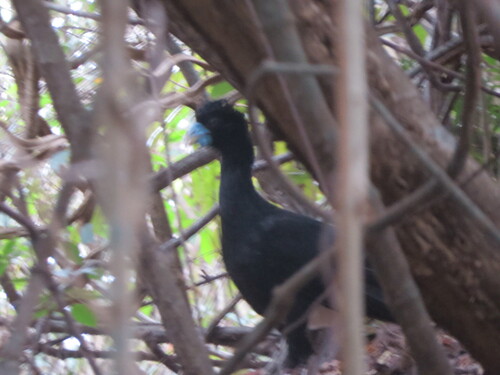 Blue-billed CurassowCrax albertiThe blue-billed curassow is 82.5 to 92.5 cm (2.7 to 3.0 ft) long and weighs 3.2 to 3.6 kg (7.1 to 7.9 lb).
Learn the Nocturnal Curassow in the BeakBrain App
Photo and call practice. Coming soon to iPhone and Android.
Play today's Daily BirdEvery photo and recording on this page is credited to its author under the licence shown. Spotted a problem with this page, or have a better photo? Contribute.