Learn what every symbol on the card means.Full credits and sources at beakbrain.com/symbols
 WoodlandMedium · 110 g

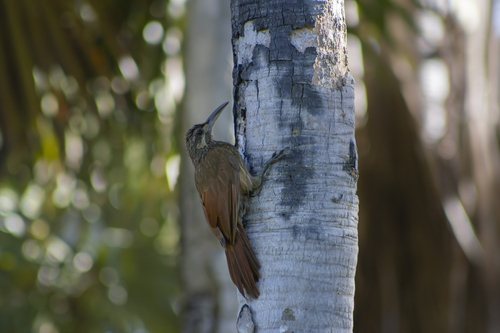
ID tip
The moustached woodcreeper is one of the largest members of its subfamily. It is heavy-bodied, with a shortish tail and a long thin bill. It is 28 to 32 cm (11 to 13 in) long and weighs about 110 g (3.9 oz). The sexes have the same plumage. Adults of the nominate subspecies have a brown face with a buffy supercilium, lores, and moustachial stripe. Their crown is cinnamon-brown to dark olive-brown with thin buff streaks. Their back is rufous-brown and their rump, wings, and tail are cinnamon-rufous. Their throat is pale buffy to whitish and their underparts light brown to cinnamon-buff. Voice: The moustached woodcreeper's song is a "series of 4-7 double-notes, like 'wèèè-TJUH wèèè-TJUH - -'." The notes often gradually change to "Tu-Tjuh". Its call is a "whining, drawn-out 'wèèè-tuh' " with the "tuh" being "high and dry".
Text from Wikipedia, licensed CC BY-SA 4.0.
When to see the Moustached Woodcreeper
One bar for each month, and every month is filled: this bird is recorded here in all twelve. The wide bar is March, the month with the most records.
Where to see the Moustached Woodcreeper
The map shades 1 country with regular records. Everything unshaded has no records. Countries are listed below the map.
About the Moustached Woodcreeper
The moustached woodcreeper is a Vulnerable species of bird in the subfamily Dendrocolaptinae of the ovenbird family Furnariidae. It is endemic to Brazil.
Text adapted from Wikipedia, licensed CC BY-SA 4.0.
Easily confused with
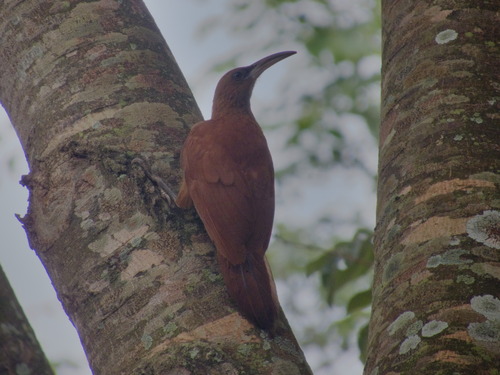 Great Rufous WoodcreeperXiphocolaptes majorThe great rufous woodcreeper is the largest, though not the heaviest, member of its subfamily.
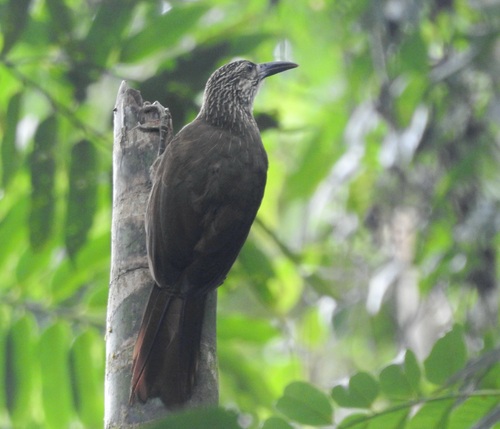 White-throated WoodcreeperXiphocolaptes albicollisThe white-throated woodcreeper is one of the largest members of its subfamily.
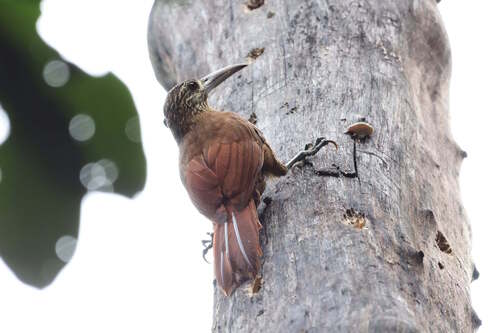 Strong-billed WoodcreeperXiphocolaptes promeropirhynchusThe strong-billed woodcreeper one of the largest members of the ovenbird family and is the heaviest woodcreeper, though the slender long-billed woodcreeper (Nasica longirostris) is longer and the great rufous woodcreeper (Xiphocolaptes major) is larger overall.
Learn the Moustached Woodcreeper in the BeakBrain App
Photo and call practice. Coming soon to iPhone and Android.
Play today's Daily BirdEvery photo and recording on this page is credited to its author under the licence shown. Spotted a problem with this page, or have a better photo? Contribute.