Learn what every symbol on the card means.Full credits and sources at beakbrain.com/symbols
 WoodlandCavity nestMedium · 156 g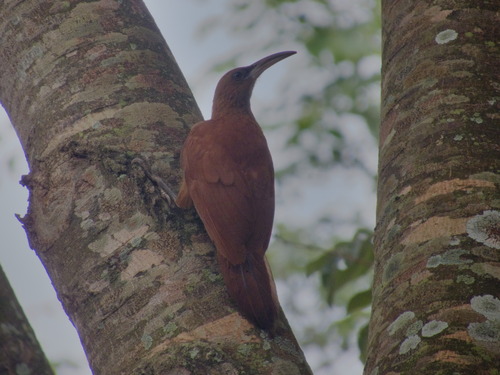
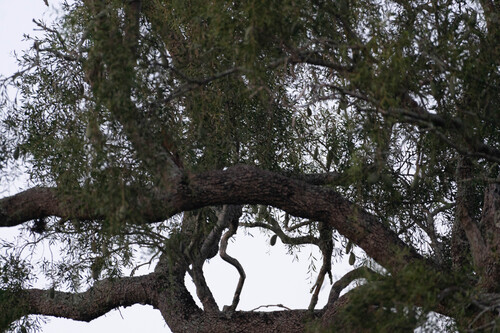


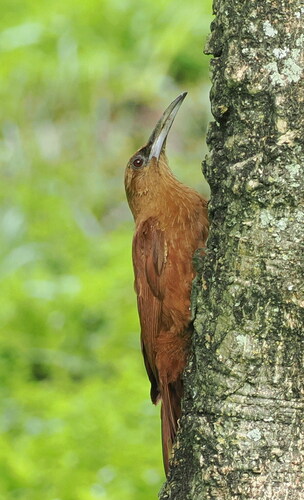
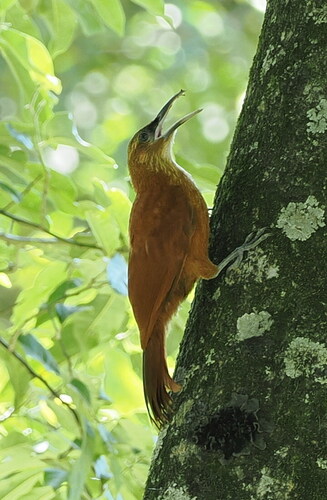
ID tip
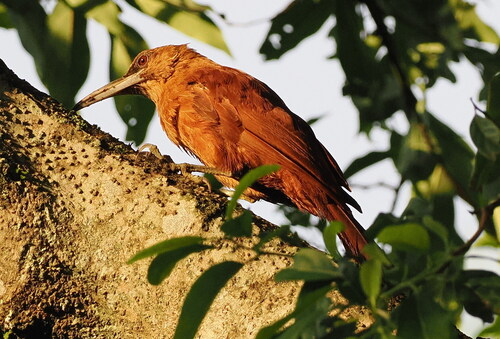
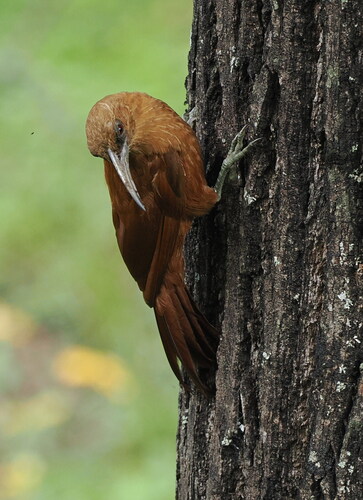
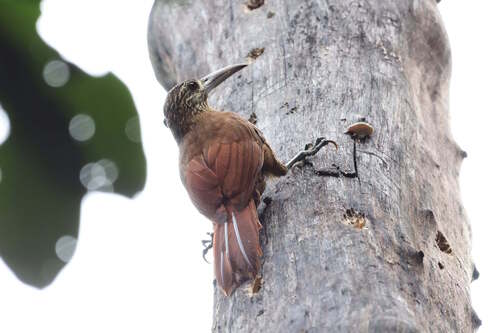
The great rufous woodcreeper is the largest, though not the heaviest, member of its subfamily. It is heavy-bodied with a long, heavy, somewhat decurved bill. It is 27 to 34 cm (11 to 13 in) long. Males weigh 120 to 150 g (4.2 to 5.3 oz) and females 120 to 162 g (4.2 to 5.7 oz). The sexes have the same plumage. Adults of the nominate subspecies X. m. major are almost entirely bright rufous-cinnamon. Their crown is slightly darker, their tail more chestnut, and their flight feathers reddish brown with dusky tips on the primaries. Voice: The great rufous woodcreeper's song is a "slightly descending series of 5-8 double-noted whistles, like 'wéettuck - -'." It has a "loud, ringing quality". The species gives a "two-part call... emphatic...'eeehr-eek!'."
Text from Wikipedia, licensed CC BY-SA 4.0.
When to see the Great Rufous Woodcreeper
One bar for each month. Filled bars are the 11 months with records; pale bars are months with none. The wide bar is October, the month with the most records.
Where to see the Great Rufous Woodcreeper
The map shades 4 countries with regular records. Everything unshaded has no records. Countries are listed below the map.
About the Great Rufous Woodcreeper
The great rufous woodcreeper is a species of bird in the subfamily Dendrocolaptinae of the ovenbird family Furnariidae. It is found in Argentina, Bolivia, Brazil, and Paraguay.
Text adapted from Wikipedia, licensed CC BY-SA 4.0.
Easily confused with
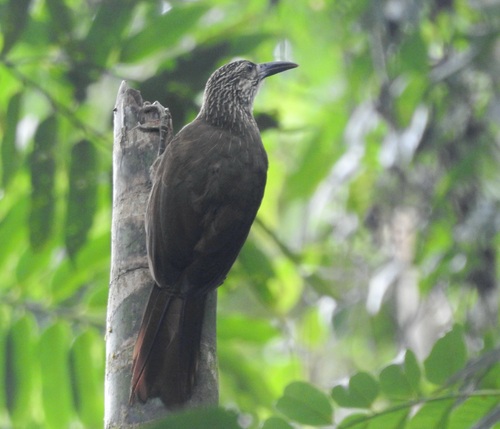 White-throated WoodcreeperXiphocolaptes albicollisThe white-throated woodcreeper is one of the largest members of its subfamily.
 Moustached WoodcreeperXiphocolaptes falcirostrisThe moustached woodcreeper is one of the largest members of its subfamily.
 Strong-billed WoodcreeperXiphocolaptes promeropirhynchusThe strong-billed woodcreeper one of the largest members of the ovenbird family and is the heaviest woodcreeper, though the slender long-billed woodcreeper (Nasica longirostris) is longer and the great rufous woodcreeper (Xiphocolaptes major) is larger overall.
Side by side: Great Rufous Woodcreeper vs Strong-billed Woodcreeper · Great Rufous Woodcreeper vs White-throated Woodcreeper
Learn the Great Rufous Woodcreeper in the BeakBrain App
Photo and call practice. Coming soon to iPhone and Android.
Play today's Daily BirdEvery photo and recording on this page is credited to its author under the licence shown. Spotted a problem with this page, or have a better photo? Contribute.