Learn what every symbol on the card means.Full credits and sources at beakbrain.com/symbols
 UrbanPlatform nestMedium · 119 g


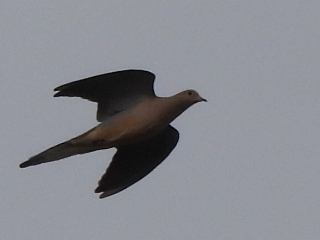
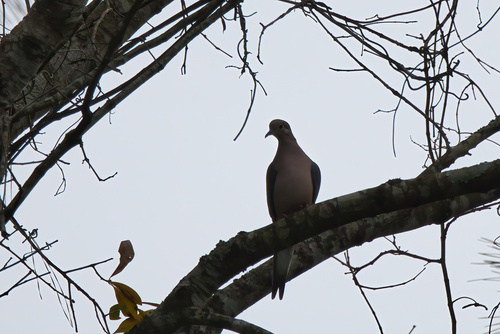
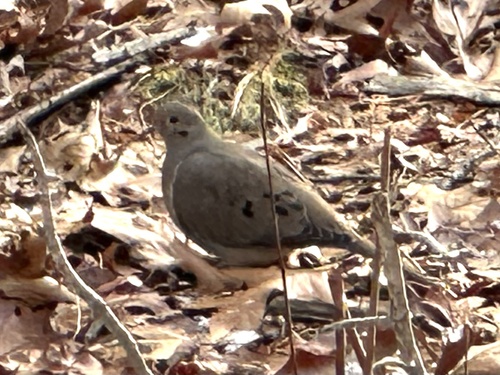
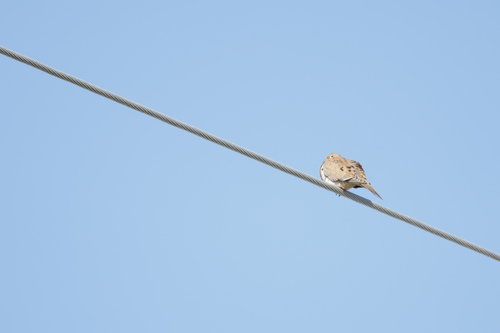
What the Mourning Dove sounds like


ID tip
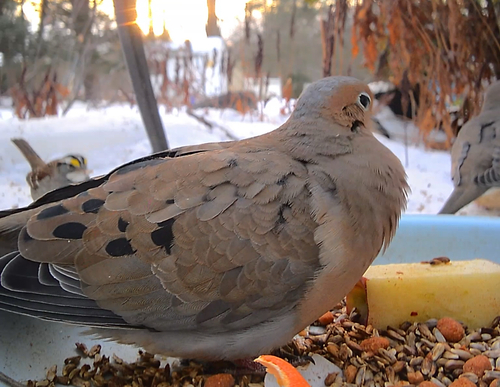
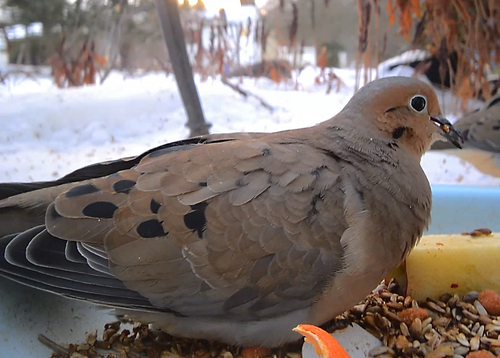
The mourning dove is a medium-sized, slender dove approximately 31 cm (12 in) in length. Mourning doves weigh 112–170 g (4.0–6.0 oz), usually closer to 128 g (4.5 oz). The mourning dove has a wingspan of 37–45 cm. The elliptical wings are broad, and the head is rounded. Its tail is long and tapered ("macroura" comes from the Greek words for "large" and "tail"). Mourning doves have perching feet, with three toes forward and one reversed. The legs are short and reddish colored. The beak is short and dark, usually a brown-black hue. Voice: This species' call is a distinctive, plaintive cooOOoo-wooo-woo-woooo, uttered by males to attract females, and it may be mistaken for the call of an owl at first. During the call, the throat of the dove swells. Close up, a grating or throat-rattling sound may be heard preceding the first coo.
Text from Wikipedia, licensed CC BY-SA 4.0.
When to see the Mourning Dove
One bar for each month, and every month is filled: this bird is recorded here in all twelve. The wide bar is May, the month with the most records.
Where to see the Mourning Dove
The map shades 21 countries with regular records, and 7 more in a lighter tone where the bird turns up only as a stray. Everything unshaded has no records. Countries are listed below the map.
Recorded as a rare visitor in United Kingdom, Portugal, Ireland, Denmark, Spain, Colombia, Guadeloupe.
About the Mourning Dove
The mourning dove is a member of the dove family, Columbidae. The bird is also known as the American mourning dove, the rain dove, and colloquially as the turtle dove, and it was once known as the Carolina pigeon and Carolina turtledove. It is one of the most abundant and widespread North American birds and a popular gamebird, with more than 20 million birds shot annually in the U.S., both for sport and meat. Its ability to sustain its population under such pressure is due to its prolific breeding; in warm areas, one pair may raise up to six broods of two young each in a single year. The wings make an unusual whistling sound upon take-off and landing, a form of sonation.
Text adapted from Wikipedia, licensed CC BY-SA 4.0.
Easily confused with
 White-winged DoveZenaida asiaticaWhite-winged doves are a plump, medium-sized bird (large for a dove), at 29 cm (11 in) from tip to tail, and a weight of 150 g (5.3 oz).
 Eared DoveZenaida auriculataThe eared dove is 24 cm (9.4 in) long with a long, wedge-shaped tail, and weighs normally about 112 g (4.0 oz).
 Zenaida DoveZenaida auritaThe Zenaida dove is approximately 28–30 cm (11–12 in) in length.
Side by side: Mourning Dove vs White-winged Dove · Eared Dove vs Mourning Dove · Mourning Dove vs Zenaida Dove
Learn the Mourning Dove in the BeakBrain App
Photo and call practice. Coming soon to iPhone and Android.
Play today's Daily BirdEvery photo and recording on this page is credited to its author under the licence shown. Spotted a problem with this page, or have a better photo? Contribute.