Learn what every symbol on the card means.Full credits and sources at beakbrain.com/symbols
 ShrublandPlatform nestMedium · 153 g


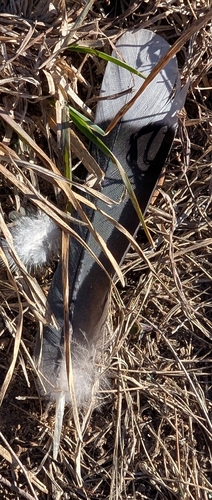
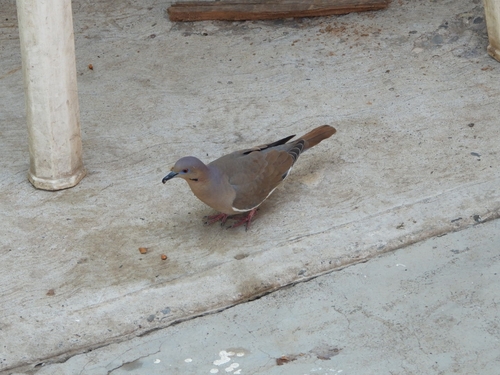


ID tip
White-winged doves are a plump, medium-sized bird (large for a dove), at 29 cm (11 in) from tip to tail, and a weight of 150 g (5.3 oz). Wingspan ranges from 18.9 to 22.8 in (48–58 cm). They are brownish-gray above and gray below, with a bold white wing patch that appears as a brilliant white crescent in flight, and is also visible at rest. Adults have a ring of blue, featherless skin around each eye and a long, dark mark on the lower face. They have a blue eye ring, and their legs and feet are brighter pink/red. Their eyes are bright crimson, except for juveniles, who have brown eyes. Voice: David Sibley describes the call as a hhhHEPEP pou poooo, likening it to the English phrase "who cooks for you". They also make a pep pair pooa paair pooa paair pooa call, with the last two words being repeated at length. Males sit on dedicated perches to give their call, which is referred to as a "coo". Calling is most frequent during the breeding season, and peaks in May and June.
Text from Wikipedia, licensed CC BY-SA 4.0.
When to see the White-winged Dove
One bar for each month, and every month is filled: this bird is recorded here in all twelve. The wide bar is April, the month with the most records.
Where to see the White-winged Dove
The map shades 31 countries with regular records, and 4 more in a lighter tone where the bird turns up only as a stray. Everything unshaded has no records. Countries are listed below the map.
Recorded as a rare visitor in Ecuador, Peru, Martinique, St. Lucia.
About the White-winged Dove
The white-winged dove is a dove whose native range extends from the Southwestern United States through Mexico, Central America, and the Caribbean. They are large for doves, and can be distinguished from similar doves by the distinctive white edge on their wings. They have a blue eyering and red eyes. The plumage is brownish-gray to gray. Juveniles are duller in color and have brown eyes. The call is likened to the English phrase "who cooks for you". There are three subspecies. It was first described by George Edwards in 1743, and given its binomial name by Linnaeus in 1756. It was moved into the genus Zenaida in 1838.
Text adapted from Wikipedia, licensed CC BY-SA 4.0.
Easily confused with
 Eared DoveZenaida auriculataThe eared dove is 24 cm (9.4 in) long with a long, wedge-shaped tail, and weighs normally about 112 g (4.0 oz).
 Zenaida DoveZenaida auritaThe Zenaida dove is approximately 28–30 cm (11–12 in) in length.
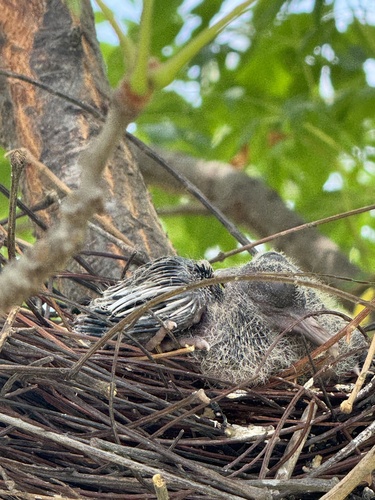 West Peruvian DoveZenaida melodaThe West Peruvian dove is a medium-sized dove, being 25–33 cm (9.8–13.0 in) and weighing around 216 g (0.476 lb).
Side by side: Mourning Dove vs White-winged Dove · Eared Dove vs White-winged Dove · White-winged Dove vs Zenaida Dove · West Peruvian Dove vs White-winged Dove
Learn the White-winged Dove in the BeakBrain App
Photo and call practice. Coming soon to iPhone and Android.
Play today's Daily BirdEvery photo and recording on this page is credited to its author under the licence shown. Spotted a problem with this page, or have a better photo? Contribute.