Learn what every symbol on the card means.Full credits and sources at beakbrain.com/symbols
 ForestPlatform nestMedium · 113 g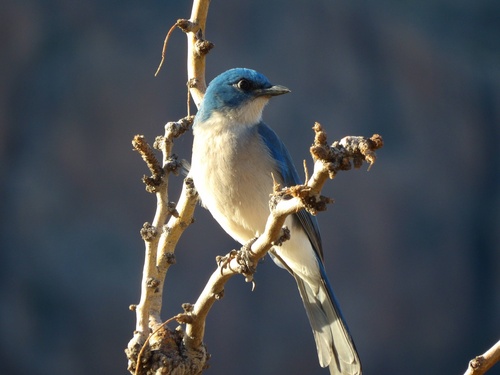


ID tip
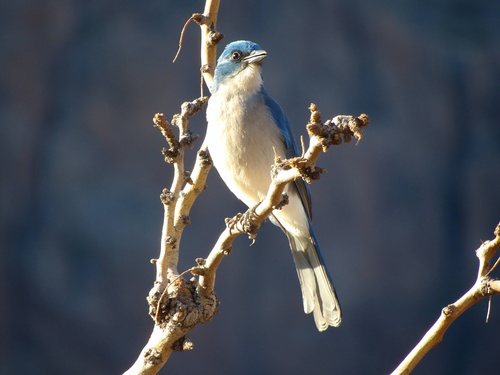
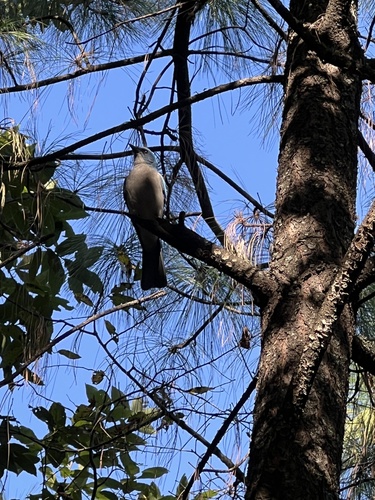
The Mexican jay is a medium-large (~120 g) passerine similar in size to most other jays, with a blue head, blue-gray mantle, blue wings and tail, and pale gray breast and underparts. The sexes are morphologically similar, and juveniles differ only in having less blue coloration and, in some populations, a pink/pale (instead of black) bill that progressively becomes more black with age (Brown and Horvath 1989). Some field guides misreport this color as yellow because the pale bill becomes yellow in museum study skins. The iris is brown and legs are black.
Text from Wikipedia, licensed CC BY-SA 4.0.
When to see the Mexican Jay
One bar for each month, and every month is filled: this bird is recorded here in all twelve. The wide bar is May, the month with the most records.
Where to see the Mexican Jay
The map shades 2 countries with regular records. Everything unshaded has no records. Countries are listed below the map.
About the Mexican Jay
The Mexican jay formerly known as the gray-breasted jay, is a New World jay native to the Sierra Madre Oriental, Sierra Madre Occidental, and Central Plateau of Mexico and parts of the southwestern United States. In May 2011, the American Ornithologists' Union voted to split the Mexican jay into two species, one retaining the common name Mexican jay and one called the Transvolcanic jay. The Mexican jay is a medium-sized jay with blue upper parts and pale gray underparts. It resembles the Woodhouse's scrub-jay, but has an unstreaked throat and breast. It feeds largely on acorns and pine nuts, but includes many other plant and animal foods in its diet.
Text adapted from Wikipedia, licensed CC BY-SA 4.0.
Easily confused with
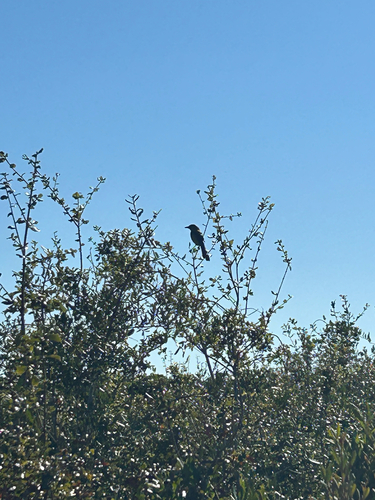 Florida Scrub JayAphelocoma coerulescensIt measures 23 to 28 cm (9.1 to 11.0 in) in length, and weighs from 66 to 92 g (2.3 to 3.2 oz), with an average 80.2 g (2.83 oz).
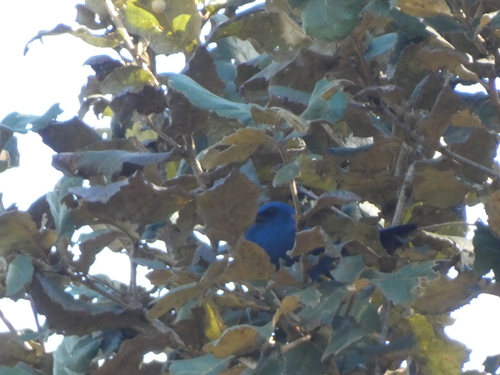 Unicolored JayAphelocoma unicolorThe unicolored jay is about 34 cm (13 in) long.
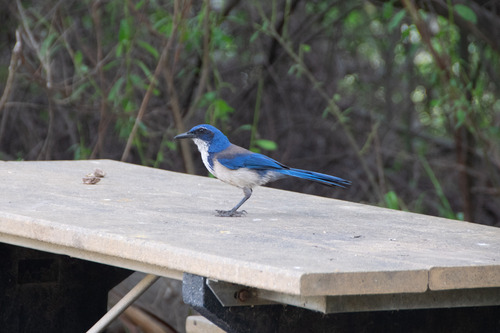 Island Scrub JayAphelocoma insularisThe island scrub jay is closely related to the California scrub jay (the coastal population found on the adjacent mainland), but differs in being larger, more brightly colored, and having a markedly stouter bill.
Side by side: California Scrub Jay vs Mexican Jay · Mexican Jay vs Woodhouse's Scrub Jay · Florida Scrub Jay vs Mexican Jay · Mexican Jay vs Unicolored Jay · Island Scrub Jay vs Mexican Jay
Watch the Mexican Jay on live cams
 LIVE
LIVEBrowse all 118 bird cams worldwide, live and seasonal, by region and species.
Learn the Mexican Jay in the BeakBrain App
Photo and call practice. Coming soon to iPhone and Android.
Play today's Daily BirdEvery photo and recording on this page is credited to its author under the licence shown. Spotted a problem with this page, or have a better photo? Contribute.