Learn what every symbol on the card means.Full credits and sources at beakbrain.com/symbols
 ForestCup nestSmall · 17 g


What the Masked Flowerpiercer sounds like


ID tip
The masked flowerpiercer grows to a length of about 15 cm (6 in). The adult male is deep ultramarine blue with a dark mask. The beak is large, black, and upturned, with a characteristic hook on the tip of the upper mandible. The iris is bright red. The female is similar in appearance but altogether duller. The juvenile has a reddish-brown iris. At the northern end of its range, the song is a series of reedlike notes terminating in a twitter, while at the southern end, it is a jangling series of high-pitched notes ending with several lengthy "tseee" notes.
Text from Wikipedia, licensed CC BY-SA 4.0.
When to see the Masked Flowerpiercer
One bar for each month, and every month is filled: this bird is recorded here in all twelve. The wide bar is November, the month with the most records.
Where to see the Masked Flowerpiercer
The map shades 5 countries with regular records. Everything unshaded has no records. Countries are listed below the map.
About the Masked Flowerpiercer
The masked flowerpiercer is a species of bird in the tanager family, Thraupidae. It is found in humid montane forest and scrub in Venezuela, Colombia, Ecuador, Peru and Bolivia. Flowerpiercers got their name from the fact that they have a sharp hook on the tip of their upper mandible which they use to slice open the base of flowers to get at the nectar.
Text adapted from Wikipedia, licensed CC BY-SA 4.0.
Easily confused with
 White-sided FlowerpiercerDiglossa albilateraA fairly small flowerpiercer - slightly larger than a black-capped chickadee and slightly smaller than a great tit.
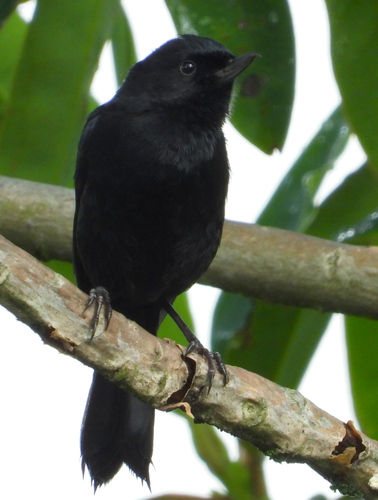 Black FlowerpiercerDiglossa humeralisAdult black flowerpiercers are 13–14 cm in length.
 Slaty FlowerpiercerDiglossa plumbeaThe slaty flowerpiercer is a passerine bird endemic to the Talamancan montane forests.
Side by side: Masked Flowerpiercer vs Swallow Tanager · Masked Flowerpiercer vs White-sided Flowerpiercer · Black Flowerpiercer vs Masked Flowerpiercer
Learn the Masked Flowerpiercer in the BeakBrain App
Photo and call practice. Coming soon to iPhone and Android.
Play today's Daily BirdEvery photo and recording on this page is credited to its author under the licence shown. Spotted a problem with this page, or have a better photo? Contribute.