Learn what every symbol on the card means.Full credits and sources at beakbrain.com/symbols
 ForestCavity nestMedium · 183 g


ID tip
The maned owl gets its name from the long, floppy, white-tipped feathers on its crown and ear tufts which seem to form a mane. Otherwise it is a medium-sized, large-headed, rufous owl. The upperparts are deep chestnut with narrow, wavy dark bars, which are darker on the lesser wing coverts and on the head, so that they contrast with the white forehead and tips to the ear-tufts. The facial disk is rufous with a broad blackish rim and a white throat. The upper breast is rufous with white bars, the lower breast and belly are buff with dark streaks while the vent and legs are pale buff.
Text from Wikipedia, licensed CC BY-SA 4.0.
When to see the Maned Owl
One bar for each month. Filled bars are the 7 months with records; pale bars are months with none. The wide bar is February, the month with the most records.
Where to see the Maned Owl
The map shades 1 country with regular records, and 2 more in a lighter tone where the bird turns up only as a stray. Everything unshaded has no records. Countries are listed below the map.
Recorded as a rare visitor in Congo - Kinshasa, Equatorial Guinea.
About the Maned Owl
The maned owl or the Akun scops owl, is a species of owl in the family Strigidae that is endemic to Africa. It is the only species in genus Jubula.
Text adapted from Wikipedia, licensed CC BY-SA 4.0.
Easily confused with
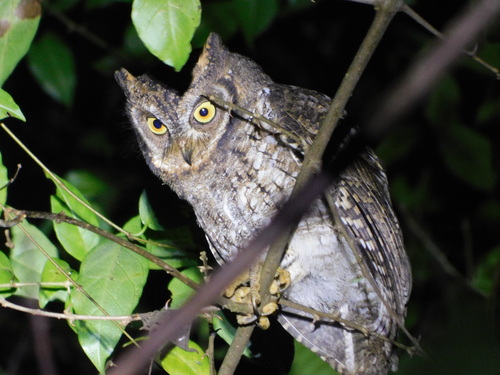 Rinjani Scops OwlOtus jolandaeThe Rinjani scops owl is a species of scops owl found only on Lombok in the Lesser Sunda Islands of Indonesia and its neighbouring Gili Islands.
 Desert OwlStrix hadoramiThe desert owl or desert tawny owl, formerly known as Hume's owl, is a species of owl.
Learn the Maned Owl in the BeakBrain App
Photo and call practice. Coming soon to iPhone and Android.
Play today's Daily BirdEvery photo and recording on this page is credited to its author under the licence shown. Spotted a problem with this page, or have a better photo? Contribute.