Learn what every symbol on the card means.Full credits and sources at beakbrain.com/symbols
 ForestMedium · 128 g
ID tip
Among the species complex, this owl is unique with its call of a series of clucks rather than the typical screeching of the other Philippine hawk-owls in the species complex. It is distinguished by the heavy barring on its head and belly, white throat-patch and facial disk. It is medium-sized at 20 cm tall, along with the Mindoro boobook within Philippine hawk-owl species complex. This is in between the larger Camiguin boobook, Romblon boobook and Cebu boobook at 25 cm and the smaller Luzon boobook and Mindanao boobook, which are 15 to 18 cm tall.
Text from Wikipedia, licensed CC BY-SA 4.0.
When to see the Sulu Boobook
One bar for each month. Filled bars are the 3 months with records; pale bars are months with none. The wide bar is January, the month with the most records.
Where to see the Sulu Boobook
The map shades 1 country with regular records. Everything unshaded has no records. Countries are listed below the map.
About the Sulu Boobook
The Sulu boobook or Sulu hawk-owl is a species of owl in the family Strigidae. It is endemic to the Sulu Archipelago in the Philippines. It was previously known as a subspecies of the Philippine hawk-owl, but was reclassified in 2012, as voice and other evidence suggested it was a distinct species. It is found in tropical moist lowland forest. It is threatened by habitat loss.
Text adapted from Wikipedia, licensed CC BY-SA 4.0.
Easily confused with
 Christmas BoobookNinox natalisThe Christmas Island hawk-owl is a small, rufous-brown hawk-owl with a barred breast, dark chestnut facial mask, whitish brow, lores and throat, yellow eyes, legs and feet.
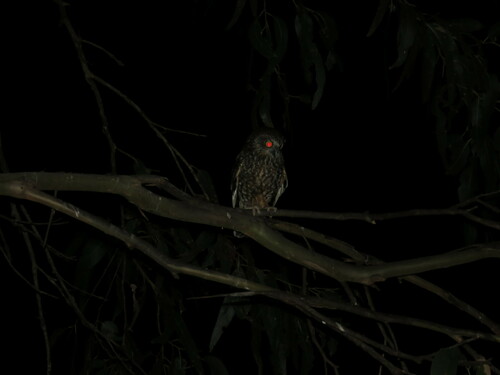 Tasmanian BoobookNinox leucopsisThe Tasmanian boobook, also known as the Tasmanian spotted owl, is a species of owl in the family Strigidae.
 Timor BoobookNinox fuscaThe Timor boobook is a species of owl in the family Strigidae.
Learn the Sulu Boobook in the BeakBrain App
Photo and call practice. Coming soon to iPhone and Android.
Play today's Daily BirdEvery photo and recording on this page is credited to its author under the licence shown. Spotted a problem with this page, or have a better photo? Contribute.