Learn what every symbol on the card means.Full credits and sources at beakbrain.com/symbols
 ForestCavity nestMedium · 62 g


ID tip
Like most other trogons, these birds are brightly coloured and sexually dimorphic. The male has a slaty-black head and breast, with a white border on the black bib separating it from the crimson on the underside. The back is olive-brown to chestnut. The wing coverts are black with fine white vermiculations. They have 12 tail feathers that are graduated. The central tail-feathers are chestnut with a black tip, with the second and third pairs from the middle having more black than chestnut. The outer three pairs have long white tips.
Text from Wikipedia, licensed CC BY-SA 4.0.
When to see the Malabar Trogon
One bar for each month. Filled bars are the 9 months with records; pale bars are months with none. The wide bar is February, the month with the most records.
Where to see the Malabar Trogon
The map shades 2 countries with regular records. Everything unshaded has no records. Countries are listed below the map.
About the Malabar Trogon
The Malabar trogon is a species of bird in the trogon family. It is found in the forests of India and Sri Lanka. In India, it is mainly found in the Western Ghats, hill forests of central India and in parts of the Eastern Ghats. They are insectivorous and although not migratory, may move seasonally in response to rain in hill forest regions. Like in other trogons, males and females vary in plumage. The birds utter low, guttural calls that can be heard only at close quarters, and perch still on a branch under the forest canopy, often facing away from the viewer, making them easy to miss despite their colourful plumage.
Text adapted from Wikipedia, licensed CC BY-SA 4.0.
Easily confused with
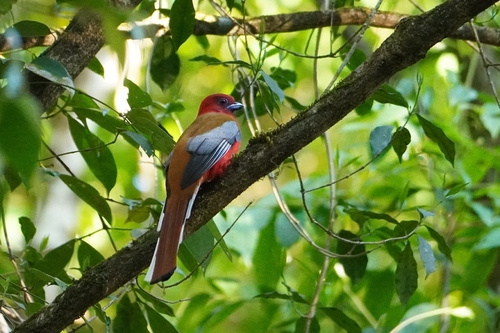 Red-headed TrogonHarpactes erythrocephalusThe red-headed trogon is on average 34 cm (13 in) in length.
 Orange-breasted TrogonHarpactes oreskiosThe orange-breasted trogon is a medium-sized bird that measures between 25 and 31 cm in length and weighs about 49 to 57 g.
 Scarlet-rumped TrogonHarpactes duvauceliiThe scarlet-rumped trogon is the world's smallest trogon, with adults measuring around 23–24 cm (9.1–9.4 in) with wings of 10 to 11 cm (3.9 to 4.3 in) in length, tails of about 11 to 13.5 cm (4.3 to 5.3 in), and weighing between 34 and 43 g (1.2 and 1.5 oz).
Side by side: Malabar Trogon vs Red-headed Trogon · Malabar Trogon vs Orange-breasted Trogon · Malabar Trogon vs Scarlet-rumped Trogon
Learn the Malabar Trogon in the BeakBrain App
Photo and call practice. Coming soon to iPhone and Android.
Play today's Daily BirdEvery photo and recording on this page is credited to its author under the licence shown. Spotted a problem with this page, or have a better photo? Contribute.