
Malabar Trogon
Harpactes fasciatus
Like most other trogons, these birds are brightly coloured and sexually dimorphic. The male has a slaty-black head and breast, with a white border on the black bib separating it from the crimson on the underside. The back is olive-brown to chestnut. The wing coverts are black with fine white vermiculations. They have 12 tail feathers that are graduated. The central tail-feathers are chestnut with a black tip, with the second and third pairs from the middle having more black than chestnut. The outer three pairs have long white tips.
ID text from Wikipedia, CC BY-SA 4.0
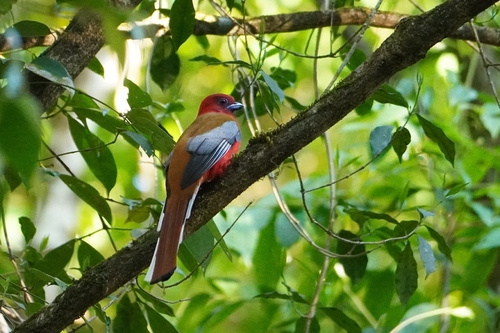
Red-headed Trogon
Harpactes erythrocephalus
The red-headed trogon is on average 34 cm (13 in) in length. The male has a red head and breast, a unique feature in the Trogon group. The female resembles the Diard's trogon without a speckled undertail. The head, neck and upper breast of an adult male is dull crimson. A narrow white band crosses the mid breast, underneath which the lower breast to abdomen is light red to pink. Pale red can be observed on the flanks whereas the mantle and back of the bird are rusty brown. The male perches on branches with the support of mauve-blue legs. Voice: The male's call resembles that of the Eurasian golden oriole (Oriolus oriolus): a sequence of usually five to six, well-spaced mellow "tyaup" notes, repeated every minute. Occasionally the male calls an extended "pluu-du" note marked by a significant terminal drop in pitch. The call is repeated every 3–6 seconds.
ID text from Wikipedia, CC BY-SA 4.0
Where you might meet both
Learn this pair in the BeakBrain App
Photo and call practice. Coming soon to iPhone and Android.
Play today's Daily BirdPhotos and recordings are credited to their authors under the licence shown. Full profiles: Malabar Trogon and Red-headed Trogon.