Learn what every symbol on the card means.Full credits and sources at beakbrain.com/symbols

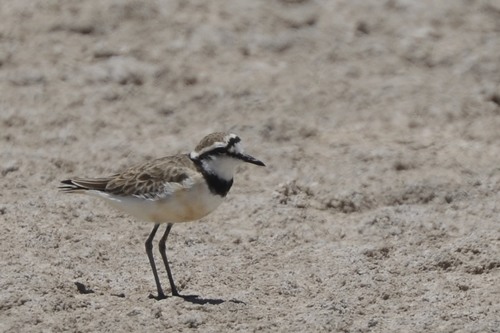
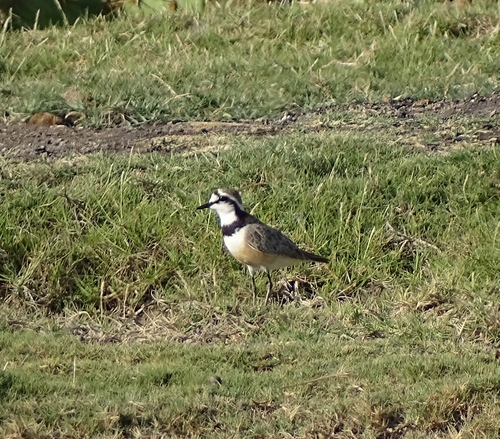

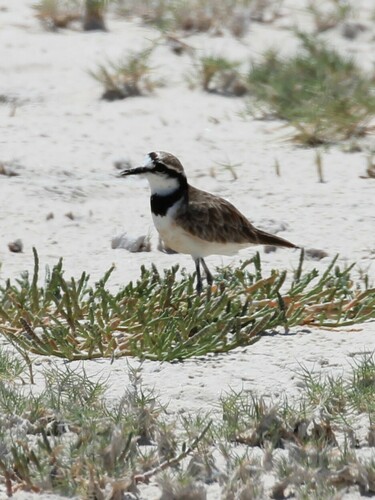
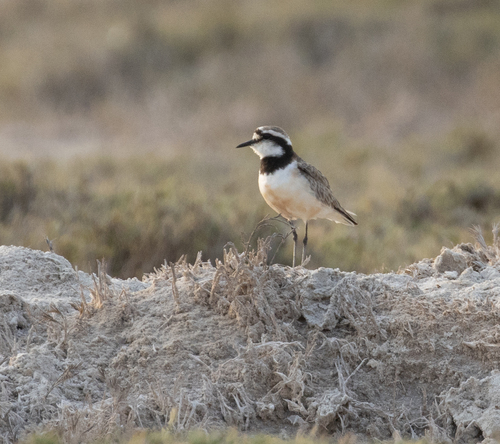
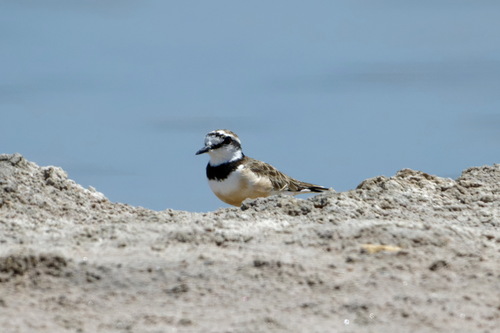
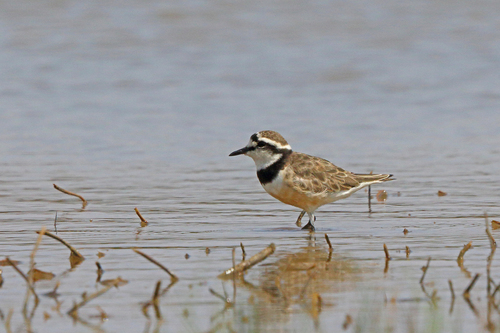
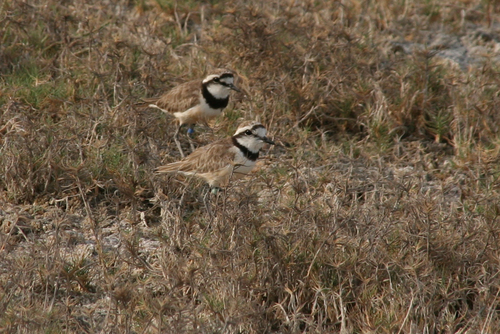
ID tip
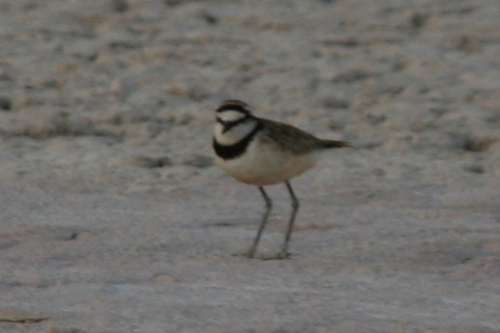
Adult males and females have sexually monomorphic plumage, however females are slightly heavier than males and have longer wings, suggesting slight sexual dimorphism. The breeding plumage of the Madagascar plover consists of a white forehead bordered by a black bar and a black crown band, with a white crown band just above. An extra black band is present running from behind the eye, around the hind neck, along with a thick black band across upper chest. The rest of the face is white. Adults weigh 31-43 g, with females weighing on average 37.8 g and males 36.4 g. Voice: Calling consists of a short 'pip' repeated every 2-3 s, as well as a 'pipipipreeeet' single note repeated rapidly 3-6 times. Adults call during the breeding season when joining groups, flying, alarming, and attending chicks. The alarm call is a 'qui qui qui qui' whilst flapping wings. When the predator is clear a 'tick tick' sound can be heard.
Text from Wikipedia, licensed CC BY-SA 4.0.
When to see the Madagascar Plover
One bar for each month. Filled bars are the 1 month with records; pale bars are months with none. The wide bar is January, the month with the most records.
About the Madagascar Plover
The Madagascar plover, also known as the black-banded plover, is a small monogamous shorebird in the family Charadriidae, native to western Madagascar. It inhabits shores of lagoons, coastal grasslands, and breeds in salt marshes. These plovers mainly nest in open grassland and dry mudflats surrounding alkaline lakes. The species is classified as vulnerable by the IUCN because of its low breeding success, slow reproductive rate, and weak adaptation to increasing habitat loss, leading to declining population numbers.
Text adapted from Wikipedia, licensed CC BY-SA 4.0.
Easily confused with
 Mountain PloverAnarhynchus montanusThe word plover came from a Latin word pluvia which means "rain".
 White-fronted PloverAnarhynchus marginatusThe average white-fronted plover weighs approximately 45-50 g, and the two sexes differ slightly in plumage coloration.
 Malaysian PloverAnarhynchus peroniiThe Malaysian plover is 15 cm (5.9 in) in length.
Learn the Madagascar Plover in the BeakBrain App
Photo and call practice. Coming soon to iPhone and Android.
Play today's Daily BirdEvery photo and recording on this page is credited to its author under the licence shown. Spotted a problem with this page, or have a better photo? Contribute.