Learn what every symbol on the card means.Full credits and sources at beakbrain.com/symbols


ID tip
The word plover came from a Latin word pluvia which means "rain". In medieval England some migratory birds became known as plovers because they returned to their breeding grounds each spring with rain. In 1832 American naturalist John Kirk Townsend spotted a species of unknown bird near the Rocky Mountains, and assumed that all these birds live in mountains. The plover comes back each spring to its breeding grounds, and so the wrong name mountain plover was given to the species. The mountain plover is 8 to 9.5 inches (20 to 24 centimetres) long and weighs about 3.7 ounces (100 grams).
Text from Wikipedia, licensed CC BY-SA 4.0.
When to see the Mountain Plover
One bar for each month. Filled bars are the 5 months with records; pale bars are months with none. The wide bar is December, the month with the most records.
Where to see the Mountain Plover
The map shades 1 country with regular records, and 1 more in a lighter tone where the bird turns up only as a stray. Everything unshaded has no records. Countries are listed below the map.
Recorded as a rare visitor in New Zealand.
About the Mountain Plover
The mountain plover is a medium-sized ground bird in the plover family (Charadriidae). It is misnamed, as it lives on level land. Unlike most plovers, it is usually not found near bodies of water or even on wet soil; it prefers dry habitat with short grass and bare ground. Its height is in the range of 5–9 inches, and length in the range of 8–10 inches ; and it weighs around 102 grams.
Text adapted from Wikipedia, licensed CC BY-SA 4.0.
Easily confused with
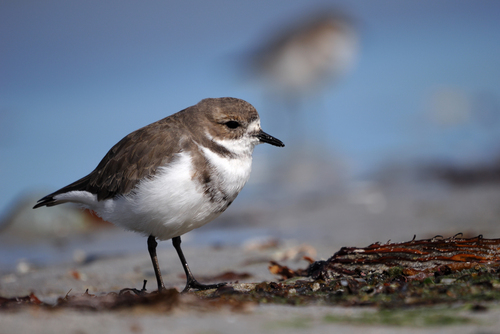 Two-banded PloverAnarhynchus falklandicusThe two-banded plover is 17 to 19 cm (6.7 to 7.5 in) long and weighs 62 to 72 g (2.2 to 2.5 oz).
 White-fronted PloverAnarhynchus marginatusThe average white-fronted plover weighs approximately 45-50 g, and the two sexes differ slightly in plumage coloration.
 Malaysian PloverAnarhynchus peroniiThe Malaysian plover is 15 cm (5.9 in) in length.
Learn the Mountain Plover in the BeakBrain App
Photo and call practice. Coming soon to iPhone and Android.
Play today's Daily BirdEvery photo and recording on this page is credited to its author under the licence shown. Spotted a problem with this page, or have a better photo? Contribute.