Learn what every symbol on the card means.Full credits and sources at beakbrain.com/symbols
 MarineScrapeMedium · 288 g

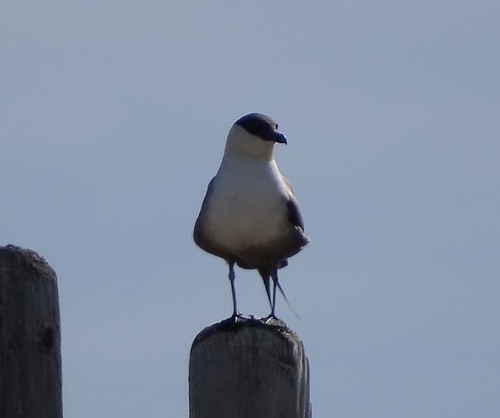
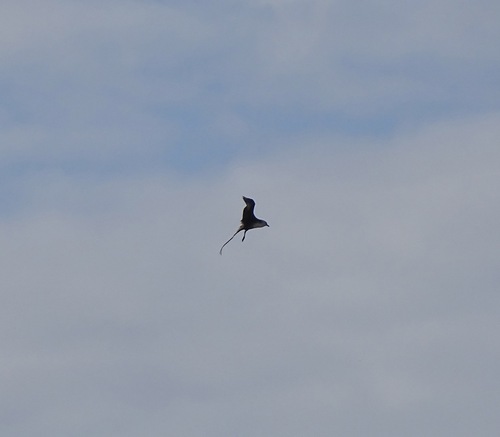


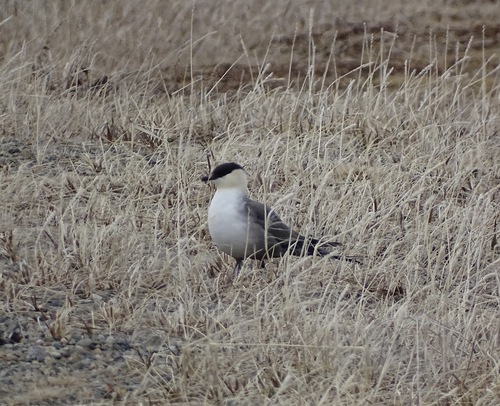
What the Long-tailed Jaeger sounds like


ID tip
This species is unmistakable as an adult, with grey back, dark primary wing feathers without a white "flash", black cap and very long tail. Adults often hover over their breeding territories. Juveniles are much more problematic, and are difficult to separate from parasitic jaeger over the sea. They are slimmer, longer-winged and more tern-like than that species, but show the same wide range of plumage variation. However, they are usually colder toned than Arctic, with greyer shades, rather than brown. This is the smallest of the skua family at 38–58 cm (15–23 in), depending on season and age.
Text from Wikipedia, licensed CC BY-SA 4.0.
When to see the Long-tailed Jaeger
One bar for each month. Filled bars are the 5 months with records; pale bars are months with none. The wide bar is June, the month with the most records.
Where to see the Long-tailed Jaeger
The map shades 65 countries with regular records, and 15 more in a lighter tone where the bird turns up only as a stray. Everything unshaded has no records. Countries are listed below the map.
Recorded as a rare visitor in India, Netherlands, Colombia, Brazil, Panama, Morocco, Puerto Rico, Türkiye, Georgia, Philippines, Réunion, Martinique, Suriname, Bulgaria, Estonia.
About the Long-tailed Jaeger
The long-tailed jaeger or long-tailed skua is a seabird in the skua family Stercorariidae.
Text adapted from Wikipedia, licensed CC BY-SA 4.0.
Easily confused with
 Great SkuaStercorarius skuaGreat skuas measure 50–58 cm (20–23 in) long and have a 125–140 cm (49–55 in) wingspan.
 Pomarine JaegerStercorarius pomarinusThis species ranges from 46 to 67 cm (18 to 26 in) in length, 110 to 138 cm (43 to 54 in) in wingspan and 540–920 g (1.19–2.03 lb) in weight.
 Chilean SkuaStercorarius chilensisChilean skuas tend to be dark on their back, flanks, and cheeks, and uniformly light underneath.
Side by side: Long-tailed Jaeger vs Parasitic Jaeger · Long-tailed Jaeger vs Pomarine Jaeger · Great Skua vs Long-tailed Jaeger · Chilean Skua vs Long-tailed Jaeger
Learn the Long-tailed Jaeger in the BeakBrain App
Photo and call practice. Coming soon to iPhone and Android.
Play today's Daily BirdEvery photo and recording on this page is credited to its author under the licence shown. Spotted a problem with this page, or have a better photo? Contribute.