Learn what every symbol on the card means.Full credits and sources at beakbrain.com/symbols
 WetlandCavity nestLarge · 871 g


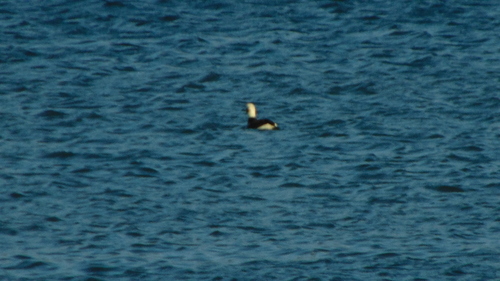
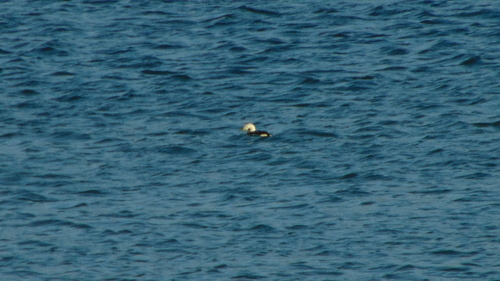
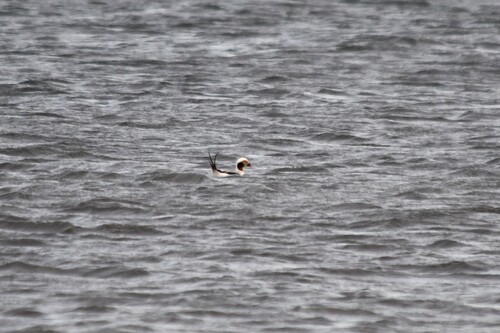
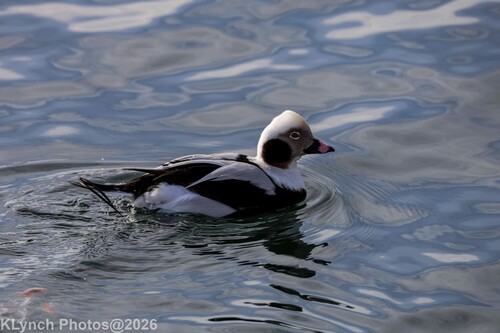
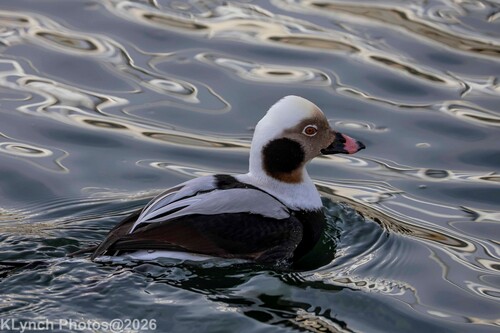
ID tip
Adults have white underparts, though the rest of the plumage goes through a complex moulting process. The male has a long pointed tail (10 to 15 cm (3.9 to 5.9 in) long) and a dark grey bill crossed by a pink band. In winter, the male has a dark cheek patch on a mainly white head and neck, a dark breast and mostly white body. In summer, the male is dark on the head, neck and back with a white cheek patch. The female has a brown back and a relatively short pointed tail. In winter, the female's head and neck are white with a dark crown. In summer, the head is dark.
Text from Wikipedia, licensed CC BY-SA 4.0.
When to see the Long-tailed Duck
One bar for each month. Filled bars are the 9 months with records; pale bars are months with none. The wide bar is January, the month with the most records.
Where to see the Long-tailed Duck
The map shades 51 countries with regular records, and 5 more in a lighter tone where the bird turns up only as a stray. Everything unshaded has no records. Countries are listed below the map.
Recorded as a rare visitor in Taiwan, India, Guernsey, Georgia, Nepal.
About the Long-tailed Duck
The long-tailed duck is a medium-sized sea duck that breeds in the tundra and taiga regions of the arctic and winters along the northern coastlines of the Atlantic and Pacific Oceans. It is the only member of the genus Clangula.
Text adapted from Wikipedia, licensed CC BY-SA 4.0.
Easily confused with
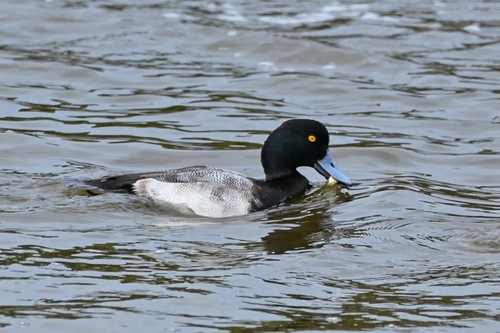 Greater ScaupAythya marilaThe adult greater scaup is 39–56 cm (15–22 in) long with a 71–84 cm (28–33 in) wingspan and a weight of 726–1,360 g (1.601–2.998 lb).
 Surf ScoterMelanitta perspicillataThe surf scoter reaches sexual maturity after 3 years.
 Egyptian GooseAlopochen aegyptiacaIt swims well and appears heavy in flight, more like a goose than a duck, hence the English name.
Side by side: Greater Scaup vs Long-tailed Duck · Long-tailed Duck vs Surf Scoter · Egyptian Goose vs Long-tailed Duck
Learn the Long-tailed Duck in the BeakBrain App
Photo and call practice. Coming soon to iPhone and Android.
Play today's Daily BirdEvery photo and recording on this page is credited to its author under the licence shown. Spotted a problem with this page, or have a better photo? Contribute.