Learn what every symbol on the card means.Full credits and sources at beakbrain.com/symbols
 GrasslandScrapeMedium · 173 g


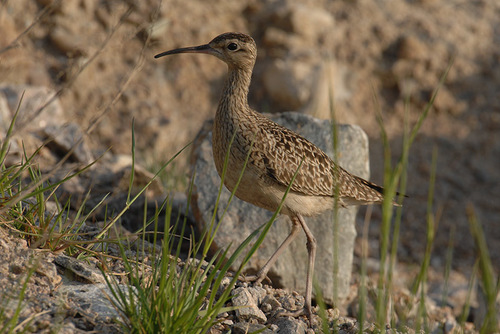
What the Little Curlew sounds like

ID tip
It is mainly greyish-brown, including the underwings, with a white belly, and a short, for a curlew, curved bill. It has a head pattern like a Eurasian whimbrel, with crown and superciliary stripes. The call is a repetitive whistle. It is the smallest species of curlew with an average length of 28–31 cm (11–12 in), an average wingspan of 68–71 cm (27–28 in) and an average weight of 175 grams (6.2 oz).
Text from Wikipedia, licensed CC BY-SA 4.0.
When to see the Little Curlew
One bar for each month. Filled bars are the 7 months with records; pale bars are months with none. The wide bar is October, the month with the most records.
Where to see the Little Curlew
The map shades 17 countries with regular records, and 6 more in a lighter tone where the bird turns up only as a stray. Everything unshaded has no records. Countries are listed below the map.
Recorded as a rare visitor in United Kingdom, Netherlands, United States, Belgium, Russia, Solomon Islands.
About the Little Curlew
The little curlew is a wader in the large bird family Scolopacidae. It is a very small curlew, which breeds in the far north of Siberia. It is closely related to the North American Eskimo curlew.
Text adapted from Wikipedia, licensed CC BY-SA 4.0.
Easily confused with
 Bristle-thighed CurlewNumenius tahitiensisThe bristle-thighed curlew has a long, decurved bill and bristled feathers at the base of the legs.
 Hudsonian WhimbrelNumenius hudsonicusThis is a fairly large wader, though mid-sized as a member of the curlew genus.
 Far Eastern CurlewNumenius madagascariensisThe Far Eastern curlew is a large wader most similar in appearance to the long-billed curlew, but slightly larger.
Side by side: Little Curlew vs Long-billed Curlew · Bristle-thighed Curlew vs Little Curlew · Hudsonian Whimbrel vs Little Curlew
Learn the Little Curlew in the BeakBrain App
Photo and call practice. Coming soon to iPhone and Android.
Play today's Daily BirdEvery photo and recording on this page is credited to its author under the licence shown. Spotted a problem with this page, or have a better photo? Contribute.