Learn what every symbol on the card means.Full credits and sources at beakbrain.com/symbols
 WetlandPlatform nestLarge · 427 g



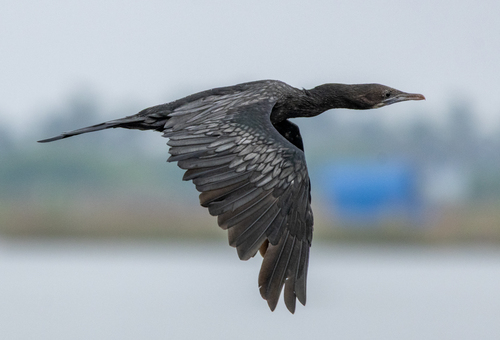
ID tip
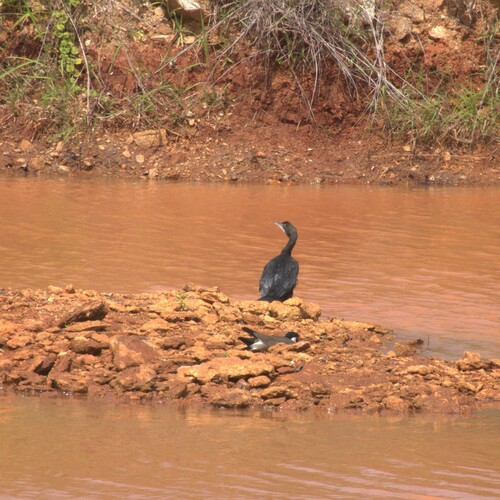
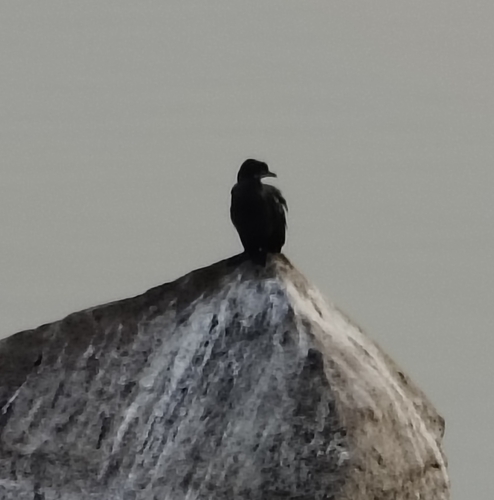
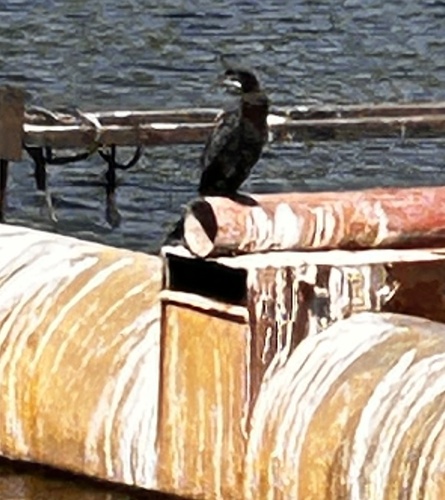
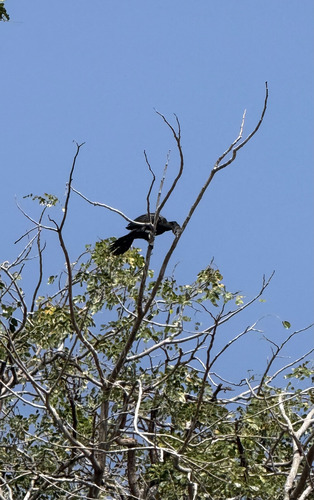
The little cormorant is about 50 centimetres (20 in) long and only slightly smaller than the Indian cormorant (Phalacrocorax fuscicollis). The Indian cormorant has a narrower and longer bill which ends in a prominent hook tip, blue iris and a more pointed head profile. The breeding adult bird has a glistening all black plumage with some white spots and filoplumes on the face. There is also a short crest on the back of the head. The eyes, gular skin and face are dark. In the non-breeding bird or juvenile, the plumage is brownish and the bill and gular skin can appear more fleshy.
Text from Wikipedia, licensed CC BY-SA 4.0.
When to see the Little Cormorant
One bar for each month, and every month is filled: this bird is recorded here in all twelve. The wide bar is January, the month with the most records.
Where to see the Little Cormorant
The map shades 14 countries with regular records. Everything unshaded has no records. Countries are listed below the map.
About the Little Cormorant
The little cormorant is a member of the cormorant family of seabirds. Slightly smaller than the Indian cormorant it lacks a peaked head and has a shorter beak. It is widely distributed across the Indian subcontinent and extends east to Java, where it is sometimes called the Javanese cormorant. It forages singly or sometimes in loose groups in lowland freshwater bodies, including small ponds, large lakes, streams and sometimes coastal estuaries. Like other cormorants, it is often found perched on a waterside rock with its wings spread out after coming out of the water.
Text adapted from Wikipedia, licensed CC BY-SA 4.0.
Easily confused with
 Little Pied CormorantMicrocarbo melanoleucosThe little pied cormorant is a small cormorant measuring 56–58 cm (22–23 in) with a shorter 3 cm (1.2 in) bill and longer tail than the little black cormorant; it has a small black crest.
 Reed CormorantMicrocarbo africanusThis is a small cormorant, 50–55 cm (20–22 in) in overall length with a wingspan of 80–90 cm (31–35 in).
 Pygmy CormorantMicrocarbo pygmaeusThe pygmy cormorant is a member of the Phalacrocoracidae (cormorant) family of seabirds.
Side by side: Little Cormorant vs Little Pied Cormorant · Little Cormorant vs Reed Cormorant · Crowned Cormorant vs Little Cormorant
Learn the Little Cormorant in the BeakBrain App
Photo and call practice. Coming soon to iPhone and Android.
Play today's Daily BirdEvery photo and recording on this page is credited to its author under the licence shown. Spotted a problem with this page, or have a better photo? Contribute.