Learn what every symbol on the card means.Full credits and sources at beakbrain.com/symbols
 GrasslandScrapeHuge · 23.9 kg


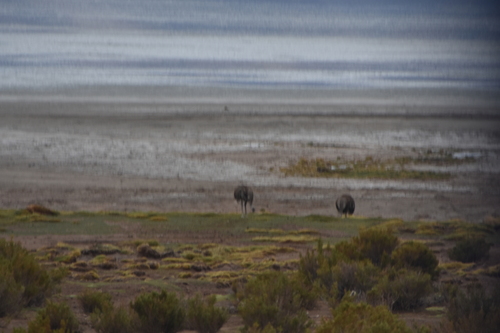


ID tip
The lesser rhea stands at 90 to 100 cm (35–39 in) tall. Length is 92 to 100 cm (36–39 in) and weight is 15 to 28.6 kg (33–63 lb). Like most ratites, it has a small head and a small bill, the latter measuring 6.2 to 9.2 cm (2.4 to 3.6 in), but has long legs and a long neck. It has relatively larger wings than other ratites, enabling it to run particularly well. It can reach speeds of 60 km/h (37 mph), enabling it to outrun predators. The sharp claws on the toes are effective weapons. Their feathers are similar to those of ostriches, in that they have no aftershaft.
Text from Wikipedia, licensed CC BY-SA 4.0.
When to see the Lesser Rhea
One bar for each month. Filled bars are the 9 months with records; pale bars are months with none. The wide bar is November, the month with the most records.
Where to see the Lesser Rhea
The map shades 4 countries with regular records. Everything unshaded has no records. Countries are listed below the map.
About the Lesser Rhea
Darwin's rhea or the lesser rhea is a large flightless bird, the smaller of the two extant species of rheas. It is found in the Altiplano and Patagonia in South America.
Text adapted from Wikipedia, licensed CC BY-SA 4.0.
Easily confused with

Side by side: Greater Rhea vs Lesser Rhea
Learn the Lesser Rhea in the BeakBrain App
Photo and call practice. Coming soon to iPhone and Android.
Play today's Daily BirdEvery photo and recording on this page is credited to its author under the licence shown. Spotted a problem with this page, or have a better photo? Contribute.